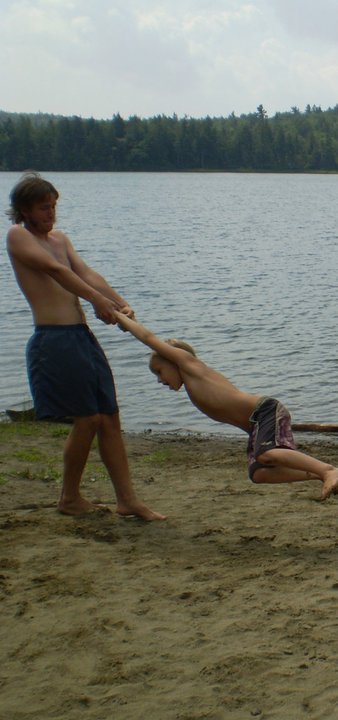
Mom, There’s a Fish in the Toilet!

Mom, There’s a Fish in the Toilet!

On the day after Irene assaulted Vermont, the word on the road was that we could be without power for up to a month. When we saw what the flood did to Route 9 (the main highway across our state) we didn’t doubt it.

My husband and I began talking about leaving. “Maybe we should head down to family in New Jersey,” he said.

But of course, we had jobs; and the kids had school–maybe; and we wanted to be in town to help when there was someway to get to the others who had been harder hit than us.

Fortunately or unfortunately, we were stuck like everyone else. No one was heading out of town on these badly damaged back roads, let alone a Honda Civic, when even the National Guard couldn’t even make it down our road with tires bigger than me.

We resigned ourselves to living the way we know how to live without power–candles, and jugs of water, and simple meals; only we couldn’t use the front porch as refrigerator as we did after a winter storm.

Once again we envied those with generators, and talked about getting one ourselves, but I was always wary about the dangers, and it wasn’t the loss of the refrigerator or the lights that hit me the hardest–but the absence of flushing toilets.

I know it’s not very Vermont of me, and I did always want an outhouse with a moon-shaped cut out on the door, but instead I sent my husband down our driveway and across the road to the pond, to fill up a bucket with water, and pour it carefully into the tank of the downstairs toilet so that we might get at least one flush a day.

Thus, the next morning, after my husband left for work, it didn’t take me long to figure out what happened when my young son called up from the bathroom to say,

“Mom, there’s a fish in the toilet!”

But it was the last straw.

“What do you mean?” I called down the stairs, just as desperately.

“A fish, Mom. There’s an actual fish in the toilet,” he replied.

“Is it alive?” I asked.

“Yes,” he answered.

“How big is it?”

And we continued this separate floor conversation like this until I told him, “Just scoop it out, and take it back to the pond.”

“Can’t I just flush it, Mom?” he asked.

“No!” I replied, “It will die. Just scoop  it out and take it back to the pond.”

I know it was a big request for a tiny thing that he’d string on a fishing pole on any other day, but after seeing the devastation to my town, I couldn’t bear another loss, however small.

“I can’t” he replied quietly.

“Why? Just get a cup or something.”

“I can’t… because I’ve already used the bathroom.”

“Pee?” I asked.

“Nope,” he replied.

“Oh.”

And so I resigned myself to sending this poor little unsuspecting fish who survived the Great Flood of 2011 to its end in our septic tank.

“Go ahead and flush,” I called to my son, as one who selfishly demanded water for her toilet.

Kelly Salasin, Marlboro, Vermont, 2011

For other posts from Vermont after the flood, click here.

Or here to read more about flushing toilets after a storm.

Feeling Worse about Feeling Better

Feeling Worse about Feeling Better

Neer, detail, visipix.com

Almost two weeks has passed since the tragedy that took place in our community Co-op, and I hate to admit this, but I’ve grown accustomed to it. Grief continues to arrive in waves, but with the tide of the news receded, it no longer floods my days.

It feels good to be relieved of the burden of shock, but is that truly a good thing? Is surrendering to murder akin to accepting it, to tolerating it, to allowing it to become a norm?

I know that I cannot go through my days somber and distraught, but how can I shop in my grocery store without feeling the bloodshed spilled there? Won’t I be dishonoring the man whose life was stolen when I talk to friends in the aisles as if it never happened?

I’ve only been back to the Co-op once since the shooting, and since I’m going out of town again this week, I can put off returning until September.

Is that a good thing?

Will I ever feel the same about my Co-op? Do I want to?

How do I reconcile feeling better when Michael Martin’s family grieves forever?

It’s not just the Co-op that’s tainted from this murder. My own community of Marlboro is too. Last night I stood under the stars with friends at an annual summer party, but I couldn’t get our neighbor, Richard Gagnon, out of my head.

When I pulled into the pond this morning for brunch, I cringed at the thought of the tennis courts where Richard played with his wife; and later that afternoon, I cringed again, when I thought I saw him walking across the beach with two friends.

Am I afraid of Richard? Of someone like Richard? Or am I simply traumatized by the fact that someone among us carried out such an act? That someone else could?

For the first time ever, murder is a topic at our family dinner table. “Are you talking about Richard?” My eleven year old asks. “No,” I reply. “We’re talking about the other murder.”

The other murder.

How is that phrase spoken in our home?  That we can talk about it at all feels good, because until now it hurt too much to admit that it had crept into our world.

Maybe that is why we all walk down the aisles of the grocery store, or gather at the pond, or under the stars without saying much about the crushing loss we must accept if we are to endure.

Kelly Salasin, August 21, 2011

For more on the BFC Tragedy, click here.

Never-Ending Summer

Never-Ending Summer

There comes a day when summer’s end is whispered almost everywhere.

Is it always a Sunday?  Or does it just feel that way because it’s August.

South Pond/detail, all rights reserved, Carol Brooke-deBock, 2011

Three weeks deep into the month that steals the sun, we gather for a potluck brunch at the pond for a second time this season.

We do the same every Friday evening, from Memorial Day to Labor Day, but the Sunday brunch is something special, arranged spontaneously by a string of unusually fair days, or in this case, by the approaching end of our time together at South Pond.

Some years we arrive for breakfast in sweatshirts, and other years in swimsuits, but always with thermoses of coffee and pitchers of orange juice and pints of just picked berries.

Either Carol or Joan (both if we’re lucky) will have a basket with something warm and cinnamon-y inside, and then there’s Don with his dish of richly crusted quiche; and Susan’s homemade goat cheese; and Andy, with eggs and meat, which he’ll fry on the grill under the bright morning sun until we are all well fed and his head is dripping with sweat.

Friends, and friends of friends, fill plates and gather around picnic tables or on blankets or in beach chairs in the sand, while young ones scurry off with bowls of fruit to nibble beside the swing set or atop of overturned boats.

Some arrive late, and heads will rise to see what new dish is added; and if empty handed, these latecomers will be encouraged to join the feast, “There’s plenty left,” we’ll say (whether there is or isn’t), and odd forks and pot lids for plates will be produced to accommodate.

South Pond, all rights reserved, Carol Brooke-deBock, 2011

No one should think on summer’s end at a time like this, and if one finds herself doing so, she should keep it private and try to talk herself out of it by thinking things like: those shadows are always just as deep beside the shade tree at this time of day; that patch of red on the distant hill is surely a decaying branch of leaves; the sudden, crisp current of the water is a relief on such a humid day.

South Pond, all rights reserved, Carol Brooke-deBock, 2011

After breakfast, we turn toward crossword puzzles or card games or conversation about the weather or politics or bovine lactation– with Coral who is off to get her doctorate in Alberta in a field that is apparently filled with possibilities.

Other young adults, once children, are asked about their college or travel plans; while other children, once babies, swim out to the dock or paddle off in kayaks, as mothers swim across the pond to the sandbar, no longer needing to look after anyone but themselves.

Someone picks up a ukulele and suddenly music makes more magic of this day. Time slows, and although we’ve all grown older together, it seems as if this morning, this pond, this community… will never end.

South Pond, all rights reserved, Carol Brooke-deBock, 2011

Thus I force my surrender into late summer’s embrace, pretending it’s not ending, as I open my novel and sink down into my chair.

The illusion is almost perfect until someone says she has to go, and calls after her kids to find a ride home if they want to stay longer.

I look around and realize that most everyone here can drive already.

By the time I finish the chapter, I see that same family, all four of them, walking in single file up the pond path.

Each of our families has distinct “pond” personalities–some arriving every afternoon and staying for dinner, others preferring quiet mornings, and yet others stopping in for a dip here and there in an otherwise full day.

As one who stays into the night, I’ve watched this particular family depart many times up the same worn path under the same trees–only now the children are taller and stronger than the parents.

Like a doorway out of the present, and away from our shared past, this family departs under a dappled light that most certainly is not summer’s.

South Pond Panoramic, Marlboro, VT, 2011; Bill Esses, all rights reserved.

Kelly Salasin, South Pond, August 21, 2011

Blueberry Communion

Blueberry Communion

On Sunday mornings in deep summer, we stroll up MacArthur Road to the farm stand atop the hill. Our walk is canopied by lush green until we arrive under the bright expanse of sky–for the morning service.

Each parishioner, barefoot or sandaled in the grass, takes communion from the tray beside the coffee pot: a golden scone filled with juicy goodness.

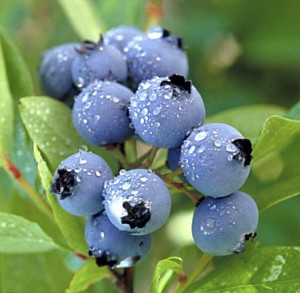
Today’s choice is raspberry or blueberry; the latter having just ripened on the hill.

I am not fit for company this morning, so I tuck a scone into my basket, and head into the field under the netting where the berries grow.

I cannot pluck a single berry without slipping into the past–falling in beside my great-grandmother Mildred in Delaware–picking and packing and canning and freezing to last us through winter.

Today, it seems I can’t pick at all. My husband has slipped in beside me and works diligently at a single bush, while I bob from plant to plant, taking in the shades of blue and purple and black, in communion with Nana.

The dew on the berries lightens the impact of yesterday’s trauma: A diving accident. A cat scan. 16 stitches. Blood pouring down my son’s face as he emerges from the pond.

This morning he is reborn. Prancing down the stairs, dressed in white, claiming, “I might as well wear something nice since I can’t do anything to get dirty.”

At 16, his life is temporarily restricted by this injury; but at 47, I feel undone, not just by what happened but what could have happened.

As my husband fills a basket with berries for breakfast, I pluck, as our youngest once did–nibbling my way through the patch–letting the sweetness of the last day of July soften my spirit on this Sunday morning.

2011

The Heart of Communication

The Heart of Communication

Degas visipix.com

The Heart of Communication Workshop

Saturday, October 2nd– 10.00-5.00 pm

At The Taoist Center, Marlboro, Vermont


Communication in its essence is a bridge that connects –  but does it?

How often do you end up feeling disconnected,  within yourself and with others,  unsatisfied with the interaction and the outcome – wondering

HOW COULD I HAVE DONE THAT DIFFERENTLY?

THERE MUST BE A BETTER WAY!!

Calpini visipix.com

There is!

Drawing on the world renowned process and practice of Nonviolent Communication, we will learn how to:

·      Build relationships based on compassion, respect and understanding, starting with ourselves and working outward

·      Tune into the needs behind anyone’s behavior,  even in hostile and challenging situations

·       Clear your thinking and language of anything that generates conflict

·      Overcome past hurts and conditioned beliefs

·      Discover the power of empathy

·      Avoid ‘power struggles’  while increasing responsibility and choice

·      Transform anger and fear, and find your authentic voice

This Workshop is facilitated by Wendy Webber

Wendy brings a background of 30 years work in the field of human potential and
relationship healing – as a core process psychotherapist (UK), a focusing teacher,
a trauma resource facilitator,  a non-certified NVC trainer,  and as a coach/mentor
for personal and organizational change.

Cost: Sliding scale of $75- $50 is requested contribution.  No one turned away for lack of funds.

Venue:  The Taoist Center, Marlboro.

Contact Wendy for further details: Phone: 802-257-5833

or  email: wendywebber1947@yahoo.com

(Note: ‘BE THE CHANGE’ weekly Practice Groups starting Tues eve Oct 5th in Brattleboro and Thurs am Oct 7th  in Marlboro –  running till mid December)

It won’t be long, I predict, before we see compassion surpass competition as the earth’s main evolutionary method… Living a compassionate life is necessary for the world to evolve.”

Penney Peirce