Things Change.

Things Change.

After the Flood, photo credit: Casey Deane, 2011, Marlboro, Vermont

Things change.

Take my mood for example.

Despite the life-threatening floods, the devastation of my road, the loss of power–and phone–and internet, I’ve been generally upbeat.

Then I got tired. And my mood soured. And I felt desperate–even after my power and my phone and my internet and almost my road were restored.

You know why? Because it was a gorgeously, hot late summer day and I couldn’t go to South Pond.

Isn’t that pathetic?

Here I have friends who have lost their homes or their businesses, and I’m depressed because they’ve closed all the swimming holes in Vermont on Labor Day Weekend.

Then again, if I withheld feeling sorry for myself until everyone else in the world had it better, I’d never get my turn at self-pity.

And what about joy? Should that be limited until everyone has it back too?

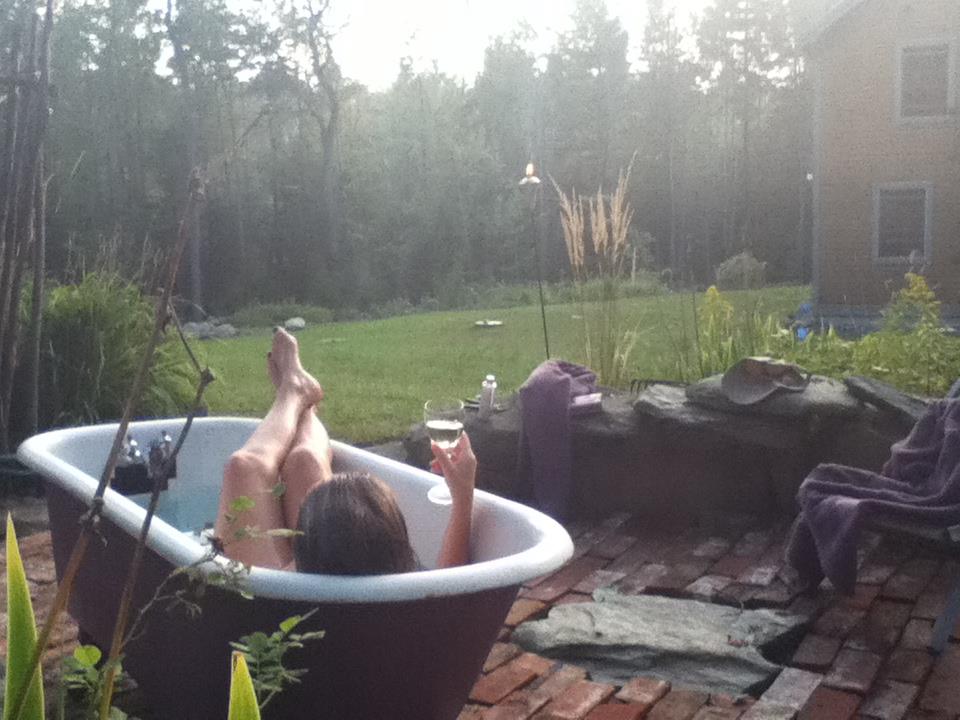
Is it okay to create a pond simulation with an outdoor bath, and glass of white wine, and a view of the setting sun in the West? (What about dancing last night to Simba on the Putney Green?)

Things change.

My mood changed after my bath, and here I am writing again in my own home instead of searching for wi-fi outside of others homes and businesses.

You should have seen the Farmers Market this morning. (Yes, I even went to the market and ate Thai food and got a massage when others were cleaning out flooded buildings and residences.)

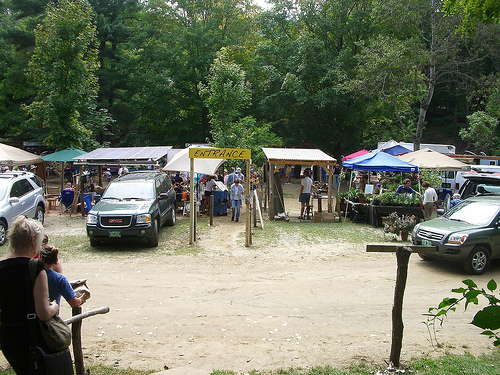
Anyway, the Brattleboro Farmers Market was washed away in the flood on Sunday, but they rebuilt it, as a community, on Thursday. At 8:00 that morning, the parking lot was already filled with volunteers and a grater at work.

A friend of mine told me that just as he put out the last picnic table on the freshly seeded dirt at the end of that day, some travelers arrived in the parking lot, walked down the hill, and set themselves up with a picnic–with no idea of the miraculous efforts that preceded it.

Isn’t that the way?

I’m told that another guy pulled in with his truck asking about the logs lying around, saying,  “Wow, you guys were lucky that you didn’t get any flooding here.”

For your reference, here’s how affected the Farmer’s Market was:

And here’s what it looked like this morning, just 6 days later:

After the flood, Brattleboro Farmers Market restored, photo credit: Amy Boemig, 2011

Things change.

Like the Co-op.

My first few trips there were unnerving, to say the least; but today’s trip had me all but forgetting that there was a murder inside–because I was so engaged in talking to others about their homes and their roads after the flood.

And then there was the afternoon a week ago when a young family nursed their baby in the Cafe and another family enjoyed dinner there–unaware that we were all reeling from loss, and afraid ourselves to step inside.

Things change; and that’s a good thing, even if it sometimes makes us feel forgotten or ignored or irrelevant, like the water that could care less what was supposed to be its bed and what was meant to be our roads.

That first morning after the flood, I wrote about the apocalyptic change the water brought to my dirt road, and to the highway a half-mile away.

Two days later, however, I returned to those forever changed places and found them relatively restored.

This change was almost as mind-blowing as the first.

Everything must change, nothing stays the same, go the lyrics from a song that once made me cry when I first came of age and watched everything I loved disappear.

Now those lyrics comfort me, knowing that not only good things change, but bad things too.

(P.S. What’s changed for the better for you?)

Kelly Salasin, Marlboro, Vermont 2011

For more on Hurricane Irene & Vermont, click here.

I’ve Known Roads…

I’ve Known Roads…

“Sidewalk Closed”, Route 9, Marlboro, VT, August 2011 (Irene); Kelly Salasin, all rights reserved

If only I could write a tribute to roads like Langston Hughes bestowed upon rivers, but there’s no poetry in me this week, and none like his.

That anything could wash away thoughts of murder inside the Co-op is unfathomable, until now. Until Irene.

On the morning after she hit our unsuspecting mountaintop town, I ran down my driveway toward Neringa Pond. There I found clusters of neighbors in sober conversation, and passed them without a word, continuing toward the mangled dock that crossed the pond where I discovered that the dam was surprisingly holding steady.

I continued down the road alone until I came to the bridge that crossed over to Camp Neringa and saw that in its place was a gaping span of… nothing.

“We’re stranded,” called a young woman from the other side over the rushing water, “There are a hundred of us.”

“I know,” I called back, “I’m so sorry this happened while you were  here.”

Bridge washed out at Neringa, MacArthur Rd, Marlboro, VT; photo: Camp Neringa, August 2011

These wedding guests had flown in from Toronto, and others from California, while one had come from as far as Lithuania.  We shouted some more across the roar of the Whetstone–about food and generators and water (all of which they had)–before turning our backs on one another on opposite sides of what had once been connected.

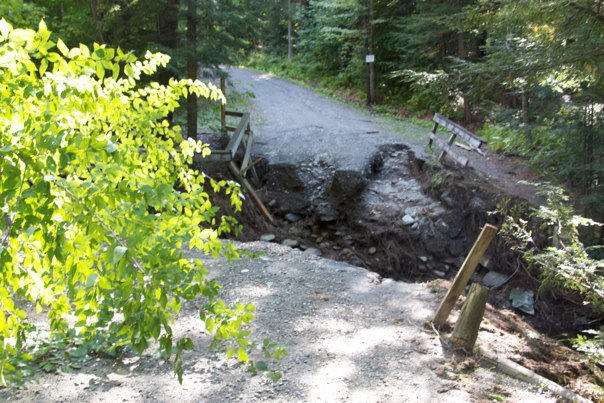
I held back tears as I continued down MacArthur Road where I came across more neighbors helping one another over the gaping pits where sections of our road once stood.

At the bottom of the hill, the underbelly of MacArthur was completely exposed–revealing gravel and dirt and a culvert many times my size.

With hesitation, I leaped over it to make my way toward the Route 9.

MacArthur Road, photo from Catherine Hamilton, August 2011.

I’ve written about the highway that crosses Southern Vermont before, about the lives its mountainous curves stole from our community—a dear friend in her twilight years, the 21-year-old nephew of the kindergarten teacher, and an 8 year-old peer of my son’s from a neighboring town.

Typically teaming with travelers, Route 9 was barren this morning, and eerily so; so clear of traffic that I could lie down in the middle of the highway and have a photo snapped of me there.

Instead I continued up it, past the hill where young Kayla died, and without any specific destination in mind.

I’d never walked along Route 9 before, at least not with such an unsettling sense of safety, and I couldn’t stop. For awhile, it was only me and the butterflies up a road where vehicles fly by at 50 or 60 miles an hour. At the crest of another hill, I passed a man coming the other way with a wax bag in his hand.

“Sweeties isn’t actually open, is it!” I asked, and he nodded his head, and kept walking.

A half-mile later, I stood inside the darkened store, relieved to see Michaela, a graduate of Marlboro College, attempting to make coffee and sandwiches for the community; and Ashleigh, a Brattleboro Highschool student, arriving to work by some heroic effort of her mother; and Rose, a town official, bending over a large map, helping travelers find routes home should any open.

I hadn’t thought to bring any cash with me when I set out this morning, but I was able to create a tab so that I could take home some groceries and a wax-bagged treat of my own while stranded guests from the other wedding across town left with six-packs, and brownie mix (which perplexes me still.)

I passed other explorers on my way back down Route 9, and when I arrived back at the intersection of MacArthur, it was crowded.  A mini-van had been abandoned there during the night, atop a pile of rocks and trees, and someone said that it had been a traveler caught up in debris when the Whetstone Brook took the road and turned Route 9 into a grander expression of itself, rushing east toward Brattleboro.

By now, the sun had risen on the day, and although I was overdressed for the coming heat and unprepared for such a trek as I had already taken, I found myself passing MacArthur by, and continuing east on Route 9, to see what others had described as indescribable.

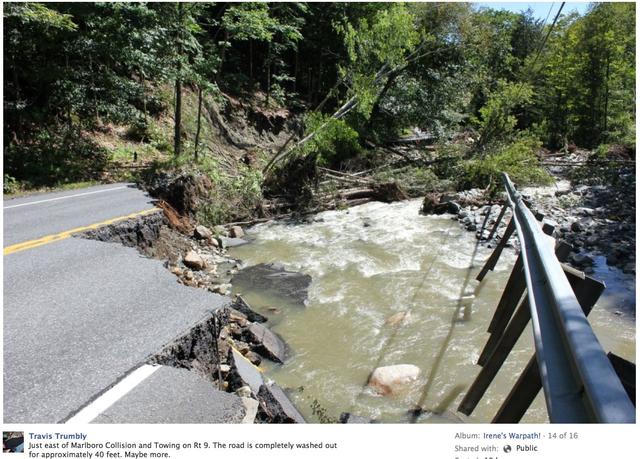
There at the edge of town, about a mile further down the highway, I approached Steve’s Auto Body Shop where half of Route 9 had neatly collapsed, right at the yellow line, into the rushing stream that didn’t used to be there below.

Beside this section of missing highway stood a small sign which politely read,  “Sidewalk Closed.”

No sign was needed for what lie just passed Steve’s. It was a destination so awe-inspiring that it had attracted elders and mothers with baby carriages for what was sure the most apocalyptic view of this flood’s devastation.

Route 9 had simply vanished, and the river took its place below. Some said a hundred, others two, and I can’t recall how many feet stood between me and the other side of what was once the highway, but it made me laugh when I recollected the span each time drivers rolled down their windows near MacArthur to ask,  “Is it passable up ahead?”

Often these travelers would persist, as if I hadn’t noticed that they had good clearance and four-wheel drive; and then I would have to be firm:

“There IS no road up ahead. It no longer exists.”

And if they still looked dubious, I would explain that even if they could, by some miraculous Evil-Knieval feat, daredevil their way across what many called the Grand Canyon, they would find similar canyons all along Route 9 heading east into Brattleboro–each with ten to twenty-foot pits below.

Then these desperate souls, hoping to get home to work or to pets or to children even, would turn their heads toward MacArthur, asking if there was any chance that way…

“Not even the National Guard, on a rescue mission, with tires bigger than your car, could get through last night.” I’d say.

Similarly, the roads heading West into Wilmington were closed, and those in the north, and in every direction; so that these drivers turned around, one by one, resigned to being stuck like the rest of us. Some slept at the church or at the Inn or inside their cars, I suspect.

By the time I  hiked back up to my house, the boys were awake and ready to do some of their own exploring. Their father took them out while I went upstairs to lie down, drifting into the sweetest, exhausted reverie I have ever known until the sound of a helicopter circling my home, not once, but three times, brought me to standing as I heard it land across the pond to sounds of cheers.

I jumped up then and dashed out my door to make my way over the mangled dock, and up the path to Neringa’s field where I came across 100 wedding guests huddled together as the chopper lifted back into the sky.

I caught the last words of an announcement made by a bearded wedding guest from Toronto: “If we have any medical emergencies, they’ll airlift them out, but for now MacArthur Road and the bridge to Neringa are not high on the priority list.”

I stayed on to talk to some of the guests, and drew maps of possible routes out of Marlboro should the backroads be cleared, and someone could come to fetch them. (They would have to leave their cars behind, most of which were rentals.)

And then I returned home once again, and slipped out of my clothes, and into bed, and slept–for the rest of the day–stirring now and again to the sound of more aircraft—the Red Cross, the governor, the National Guard—only to let my head drop heavily back on the pillow in what felt like a drugged stupor.

The air was crisp, the sky beautiful, and my home–and even my steep driveway–uncannily untouched by the devastation that was all around me.

From under my covers, the world was more tranquil than ever.  There were no cars passing on MacArthur and no whine of 18 wheelers from Route 9. The house was silent too–absent of the hum of appliances or the ringing of phones.

I couldn’t bear to think about how long we’d be without power or how much it would take to repair these roads or how hard others may have been hit, and so I slept as long as I could.

The sublime quiet brought me back to the days after 9/11–when our skies were as empty as our roads were now.

In my 47 years, I’ve known roads—mud strewn ones and flooded ones—empty ones and crowded ones–worn ones and brand new ones–but I’d never known anything like today.

My soul has grown deep with our roads, deeper than I ever knew.

Listening to the road, Kelly Salasin, August 2011

Kelly Salasin, August 2011

Hurricane Irene

Marlboro, Vermont

Resources:

Road Closings/Openings

Vermonters Helping Vermonters

FEMA Reimbursement for home & business owners in Marlboro

Governor Shumlin on CNN

Video: Neringa Before & After Neringa, including footage of MacArthur Rd & Rte 9:

Click here for more on Vermont and roads and the history of this place we call home, by road namesake, Robin MacArthur.

Tuesday, again

Tuesday, again

In exactly two weeks, “BFC Tragedy” climbs its way to the top of the list of writing topics on the sidebar of this Vermont blog–from a tiny thing at the bottom, to where it sits now–boldface, beside the prominent category of “Autumn.”

In retrospect, I wish I’d tagged this collection “BFC Healing” instead of “tragedy,” but at the time I never imagined that so much compassion would flow from murder.

Two weeks.

Doesn’t it seem like a lifetime passed since the Co-op mutated from haven to hell in an instant?

Somehow I find myself back here on a Tuesday; and this time it’s definitely easier; though I’m taken aback to see a baby in the cafe.  A baby.

Earlier this afternoon I passed tourists at the corner of Elliott and Main–two moms and a young son looking for a place to eat. I recommended the Co-op; and then wondered if I’d made a mistake.  If I was visiting, would I want to take my kids there?

I’ve left my own kids at home, but my husband has accompanied me again. I watch with tenderness as he approaches one Co-op staffer after another to offer an embrace or a pat on the shoulder.

I feel too shy to do the same, and wish I could wear a button that says, “I gave at my blog.”

“At least go see Tony in the wine department,” my husband says, over a bowl of soup.

Instead I suggest that I come back with cookies or candy–something easier to share than sentiment.

Perhaps the staff has grown weary of compassion anyway, I argue internally.  Maybe they’re trying to move on.  But the truth is that my biggest concern is that they would feel that we’ve moved on–without them.

Whenever I’m faced with uncertainty around connecting with those in grief, I think back to my friend Trish whose 18 year old brother was killed in an accident the summer we all worked together at the shore.  Everyone at the Crab House was heartbroken, but they avoided talking about Tommy so as not to make it harder on Trish.

Finally I asked her. “Does it make it worse when I talk about him?”

“No,” she answered. “I couldn’t feel any worse, and he’s on my mind all the time.”

Maybe it’s that way for everyone at the Co-op. Maybe this tragedy is always on their minds whether we acknowledge it or not.

I wonder how long it will take until I walk into that store and it’s no longer on mine.

Kelly Salasin, August 23, 2011

For more on BFC Tragedy, click here.

(ps. As I was leaving the Co-op, I saw those two moms and their young son, and they thanked me for the “great recommendation.”)

Feeling Worse about Feeling Better

Feeling Worse about Feeling Better

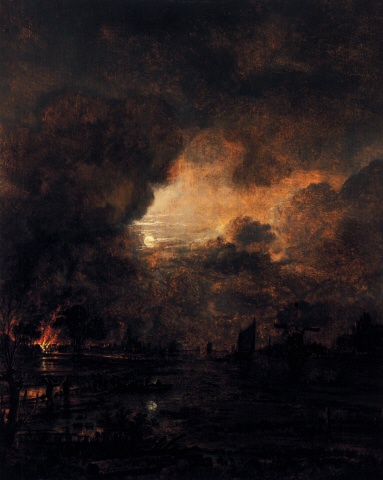
Neer, detail, visipix.com

Almost two weeks has passed since the tragedy that took place in our community Co-op, and I hate to admit this, but I’ve grown accustomed to it. Grief continues to arrive in waves, but with the tide of the news receded, it no longer floods my days.

It feels good to be relieved of the burden of shock, but is that truly a good thing? Is surrendering to murder akin to accepting it, to tolerating it, to allowing it to become a norm?

I know that I cannot go through my days somber and distraught, but how can I shop in my grocery store without feeling the bloodshed spilled there? Won’t I be dishonoring the man whose life was stolen when I talk to friends in the aisles as if it never happened?

I’ve only been back to the Co-op once since the shooting, and since I’m going out of town again this week, I can put off returning until September.

Is that a good thing?

Will I ever feel the same about my Co-op? Do I want to?

How do I reconcile feeling better when Michael Martin’s family grieves forever?

It’s not just the Co-op that’s tainted from this murder. My own community of Marlboro is too. Last night I stood under the stars with friends at an annual summer party, but I couldn’t get our neighbor, Richard Gagnon, out of my head.

When I pulled into the pond this morning for brunch, I cringed at the thought of the tennis courts where Richard played with his wife; and later that afternoon, I cringed again, when I thought I saw him walking across the beach with two friends.

Am I afraid of Richard? Of someone like Richard? Or am I simply traumatized by the fact that someone among us carried out such an act? That someone else could?

For the first time ever, murder is a topic at our family dinner table. “Are you talking about Richard?” My eleven year old asks. “No,” I reply. “We’re talking about the other murder.”

The other murder.

How is that phrase spoken in our home?  That we can talk about it at all feels good, because until now it hurt too much to admit that it had crept into our world.

Maybe that is why we all walk down the aisles of the grocery store, or gather at the pond, or under the stars without saying much about the crushing loss we must accept if we are to endure.

Kelly Salasin, August 21, 2011

For more on the BFC Tragedy, click here.

Never-Ending Summer

Never-Ending Summer

There comes a day when summer’s end is whispered almost everywhere.

Is it always a Sunday?  Or does it just feel that way because it’s August.

South Pond/detail, all rights reserved, Carol Brooke-deBock, 2011

Three weeks deep into the month that steals the sun, we gather for a potluck brunch at the pond for a second time this season.

We do the same every Friday evening, from Memorial Day to Labor Day, but the Sunday brunch is something special, arranged spontaneously by a string of unusually fair days, or in this case, by the approaching end of our time together at South Pond.

Some years we arrive for breakfast in sweatshirts, and other years in swimsuits, but always with thermoses of coffee and pitchers of orange juice and pints of just picked berries.

Either Carol or Joan (both if we’re lucky) will have a basket with something warm and cinnamon-y inside, and then there’s Don with his dish of richly crusted quiche; and Susan’s homemade goat cheese; and Andy, with eggs and meat, which he’ll fry on the grill under the bright morning sun until we are all well fed and his head is dripping with sweat.

Friends, and friends of friends, fill plates and gather around picnic tables or on blankets or in beach chairs in the sand, while young ones scurry off with bowls of fruit to nibble beside the swing set or atop of overturned boats.

Some arrive late, and heads will rise to see what new dish is added; and if empty handed, these latecomers will be encouraged to join the feast, “There’s plenty left,” we’ll say (whether there is or isn’t), and odd forks and pot lids for plates will be produced to accommodate.

South Pond, all rights reserved, Carol Brooke-deBock, 2011

No one should think on summer’s end at a time like this, and if one finds herself doing so, she should keep it private and try to talk herself out of it by thinking things like: those shadows are always just as deep beside the shade tree at this time of day; that patch of red on the distant hill is surely a decaying branch of leaves; the sudden, crisp current of the water is a relief on such a humid day.

South Pond, all rights reserved, Carol Brooke-deBock, 2011

After breakfast, we turn toward crossword puzzles or card games or conversation about the weather or politics or bovine lactation– with Coral who is off to get her doctorate in Alberta in a field that is apparently filled with possibilities.

Other young adults, once children, are asked about their college or travel plans; while other children, once babies, swim out to the dock or paddle off in kayaks, as mothers swim across the pond to the sandbar, no longer needing to look after anyone but themselves.

Someone picks up a ukulele and suddenly music makes more magic of this day. Time slows, and although we’ve all grown older together, it seems as if this morning, this pond, this community… will never end.

South Pond, all rights reserved, Carol Brooke-deBock, 2011

Thus I force my surrender into late summer’s embrace, pretending it’s not ending, as I open my novel and sink down into my chair.

The illusion is almost perfect until someone says she has to go, and calls after her kids to find a ride home if they want to stay longer.

I look around and realize that most everyone here can drive already.

By the time I finish the chapter, I see that same family, all four of them, walking in single file up the pond path.

Each of our families has distinct “pond” personalities–some arriving every afternoon and staying for dinner, others preferring quiet mornings, and yet others stopping in for a dip here and there in an otherwise full day.

As one who stays into the night, I’ve watched this particular family depart many times up the same worn path under the same trees–only now the children are taller and stronger than the parents.

Like a doorway out of the present, and away from our shared past, this family departs under a dappled light that most certainly is not summer’s.

South Pond Panoramic, Marlboro, VT, 2011; Bill Esses, all rights reserved.

Kelly Salasin, South Pond, August 21, 2011