Sto. Cristo Chapel Bgy. Sto. Cristo, San Isidro, Nueva Ecija, Phil.
My husband and I lounge under the covers as a jeweled sun sparkles through the trees on its way to our sky.
When the wind blows, the forest sways, dispatching flashes of gold onto our bodies, offering a perfect sermon for a Sunday morning.
Easter 2015, A.D.
The baskets are waiting. The eggs dyed. The reservations for brunch confirmed.
Last night we watched Chocolat with Lake Champlain 5 Star Chocolate Bars, and then listened to bits and pieces of the soundtrack from Godspell, centering on the score for the Crucifixion scene.
Most memorable, however, was the moment I pulled out 4 plates (of my Nana’s china) instead of 3, because our oldest was home.
Last Supper.
He had surprised us, downtown, the night before, when we were doing what I love best–floating from place to place, bumping into something sweet–which is particularly potent on a spring evening at Gallery Walk in Brattleboro.
Good Friday.
My youngest and I had just finished our monthly stroll through the Brattleboro Museum & Art Center–one of our favorite stops through the years–where we always take time to visit the kids room to make some art of our own.
It was inside the River Garden, however, where the family first came together, as a whole, attracted by the sounds of horns, played by the stunning Brattleboro High School Jazz Band.
During a particularly poignant interlude–when my husband’s hand clasped mine, and geese flew over the river, and spring stirred inside me–I felt something I’d never felt before:
Resentment.
Toward new life.
In that moment, I knew the seasons were indifferent.
That spring would come, whether I welcomed it, or celebrated it, or–worse yet–
whether I was here for it.
Perhaps it was my age, 51, ripening past peak, or the long white winter spilling into April, or that a loved one’s life was on the line; but suddenly—the young girls in bloom, the birds return, and the color green–represented something beyond–me.
Just like winter, I would pass, and the giddy world would go on resurrecting… without me.
There are those educationalists who believe that if we can just get the curriculum and the testing right, kids will learn.
(David Holzapfel, in remarks to the Vermont Humanities Council)
photo: Francie Marbury
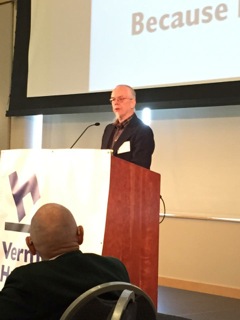
David Holzapfel has been a Windham County educator for the past 25 years. This fall his work with students was recognized by the Vermont Humanities Council (VHC) when they awarded him the Victor R. Swenson Humanities Educator Award in a ceremony that took place on the campus of the University of Vermont in November.
The annual meeting of the Vermont Humanities Council
“The Vermont Humanities Council is pleased to honor Vermont teachers in the humanities who challenge and inspire their students, who open up for them the world of ideas, and who help them know the joy of learning,” said VHC Executive Director Peter Gilbert. “In honoring one such teacher each year, we pay tribute to all the fine teachers in Vermont, and we honor the important work they do.”
The award, which comes with $1,000 prize, is given annually to a Vermont educator in grades 6 through 12 who exemplifies excellence in the teaching of the humanities.
David’s particular brand of teaching excellence was the focus of a recent interview entitled, “Not teaching to the test,” by Sarah Buckingham of The Commons in Brattleboro. She wrote:
David Holzapfel’s fifth- and sixth-grade classroom feels more like a small liberal arts college than it does a public elementary school.
The multi-age, multi-subject classrooms at Marlboro Elementary School embrace an interdisciplinary and experiential approach to education, influenced by the nearby Marlboro College.
Holzapfel says teachers there are given the freedom to teach the things that excite them: “That’s where learning becomes infectious for kids and that’s really what we want,” he says.
In this way, Holzapfel is being celebrated for doing things differently.
David admitted to Sarah that he didn’t pay attention to things like the Vermont Standards and the Common Core “and all those sorts of things.” In fact, one of his colleagues joked that he was being awarded for “doing what you’re not supposed to be doing.”
In David’s remarks at the annual VHC conference, attended by 300+ educators across the state, he addressed the policy initiatives that interfere with teaching and learning:
There are those educationalists who believe that if we can just get the curriculum and the testing right, kids will learn. Every six to eight years since I began teaching, a new educational initiative has been handed down and touted as the solution: The Public School Approval Standards, The Vermont State Standards, No Child Left Behind, Adequate Yearly Progress, Race to the Top and currently the Common Core Standards.
“The problem is,” says David, “If the curriculum standard in place (eg State Standards, No Child, etc) is so spot-on then why do we continue to change to some other grand scheme every few years? And then the new plan is touted as being the solution to the problem of why kids aren’t learning. But it’s not the curriculum, it’s not the test that drives kids to learn. It’s meaningful work, challenging work entered into with enthusiasm.”
In a recommendation letter to the Council, Principal Francie Marbury highlighted David’s passion for challenge:
David believes that students need rich content to sink their teeth into. His search for the perfect book and the most engaging activity is relentless. Long before the Common Core, David understood that the literature he chose for his students needs to be complex and challenging and that, with the proper support, they would rise to the challenge.
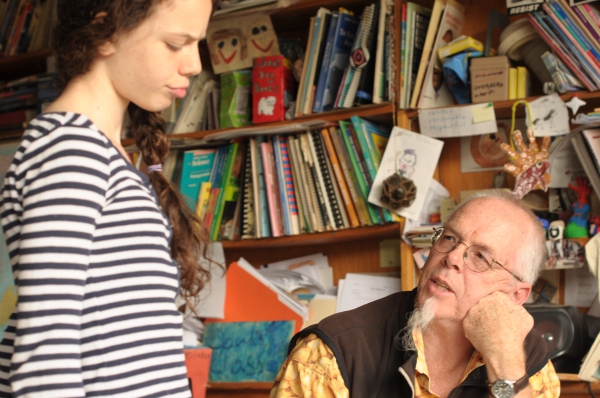
photo: The Commons, Sarah Buckingham
“‘Challenging work’ does not mean that anything goes and that anything a student does is OK,” says David. “The teacher’s job is to instruct and guide individual students to learn to be learners and to be able to communicate their understandings. That means we must study and practice the writing conventions, math facts, critical reading and thinking skills; those tools which will enable us to learn about cellular biology or how an engine works or sustainable farming practices.”
“But teaching isn’t about force-feeding widgets with information which is what the curriculum-testing model promotes,” he says. “Too often I feel that educationalists don’t really trust that kids want to be learners.”
In the article, “Not teaching to the test,” reporter Sarah Buckingham addressed David’s approach:
(It’s) not to say Holzapfel’s curriculum doesn’t meet those standards: he’s just come up with his own way of satisfying them.
Each year his students read the epic poem “The Odyssey” and memorize the first stanza of Chaucer’s “The Canterbury Tales” in the original Middle English.
“Those kinds of things don’t show up on [standardized] tests,” Holzapfel says, “and yet they’re the things kids remember and the things kids value. It becomes a part of them.”
Holzapfel says he takes issue with guidelines and standards that compartmentalize subject matter.
‘”When we’re studying astronomy we’re also reading Ray Bradbury. Everything is related to everything else. And the strictures of, ‘Well we can’t talk about math or we can’t talk about science while we’re looking at art’ is just silly. If you present the same material in as many different ways and through as many different lenses as possible then you just increase the chances of creating understanding.”
Susan Calabria, of the Brattleboro Musuem and Art Center (BMAC), was among those who recommended David to the Vermont Humanities Council for the award. As the Education Curator of BMAC she has worked closely with David and his students over the years. Susan wrote:
My first introduction to David was in my early years at the Museum (c. 2002-2003) when he participated in a VTS (Visual Thinking Strategies) symposium at BMAC. His excellent presentation – which I saw him do in his classroom with students in ensuing years – was on extending VTS to support a geometry lesson. He used a projected imagine of an M.C. Esher print as a starting point…
David was one of the first in our area to incorporate the VTS method into math, literacy, history, and science projects.
Susan spoke at length about how David took VTS into field studies with his students, combining art and science. David emphasized the role of field research in his remarks to the Council:
Field research is one of the active muscles of the humanities and is a cornerstone of learning through all the grades at the Marlboro School. Successful field research takes time and dedication, a tremendous amount of planning, support and trust. And did I mention time? The temporal aspects of learning seem rarely considered by policy-makers and yet we all know that those topics to which we dedicate time are the topics we truly know; this is immersive learning. But, to quote educator Ron Berger, “Today’s pressure is toward surface coverage of content to prepare for high stakes tests. It’s growing more difficult to give students the opportunities to use their minds well as critical thinkers, to work as historians, scientists, mathematicians and writers.” There is simply not enough time for engaged learning within our curriculum-tweaking standardized test-taking mindset. Is it any wonder that too many students seem disconnected and are bored in school?
In a press release announcing David as the recipient of the Humanities award, VHC celebrated his work in the field:
The learning journey of Holzapfel’s students goes well beyond the classroom. A major component of his sixth-grade classes is a week-long field research trip to New York City, the cornerstone of a year of study that includes a focus on immigration to America as well as students’ independent study projects. Students visit Ellis Island and the Tenement Museum and take part in other activities that illustrate the immigrant experience. Holzapfel carefully prepares students for their independent studies, which culminate in New York with students interviewing people such as a member of the New York Stock Exchange, Central Park’s landscape designer, a curator at the Museum of Natural History, a stage manager at the New York City Ballet, as well as local pedestrians.
NYC field research trip; photo: Pam Burke
“The NYC individual field work is demanding,” David admits. “Students and staff work through topic selection, pre-field work research, field work involving interviews of professionals in the study area, investigation of primary resources, collation of field notes and integration of that information with the classroom research, a final report, the generation and performance of a multi-media presentation with no established time-frame and finally, a parent-community presentation of approximately 7 minutes. That’s complex. An inch wide and a mile deep. But it’s worth the effort because when it’s done thoroughly, it engenders a true sense of accomplishment: Kids are proud of the work they’ve done because it was complex, multi-directional, and deep; and teachers are proud because they’ve led students through an authentic experience.”
David noted the challenges and rewards of field work in his remarks to the Council:
Field research is hard work for educators in the current climate. But I believe that for all those involved in direct education, students and teachers alike, nothing builds a positive sense of purpose and confidence better than the accomplishment of a difficult task done well.
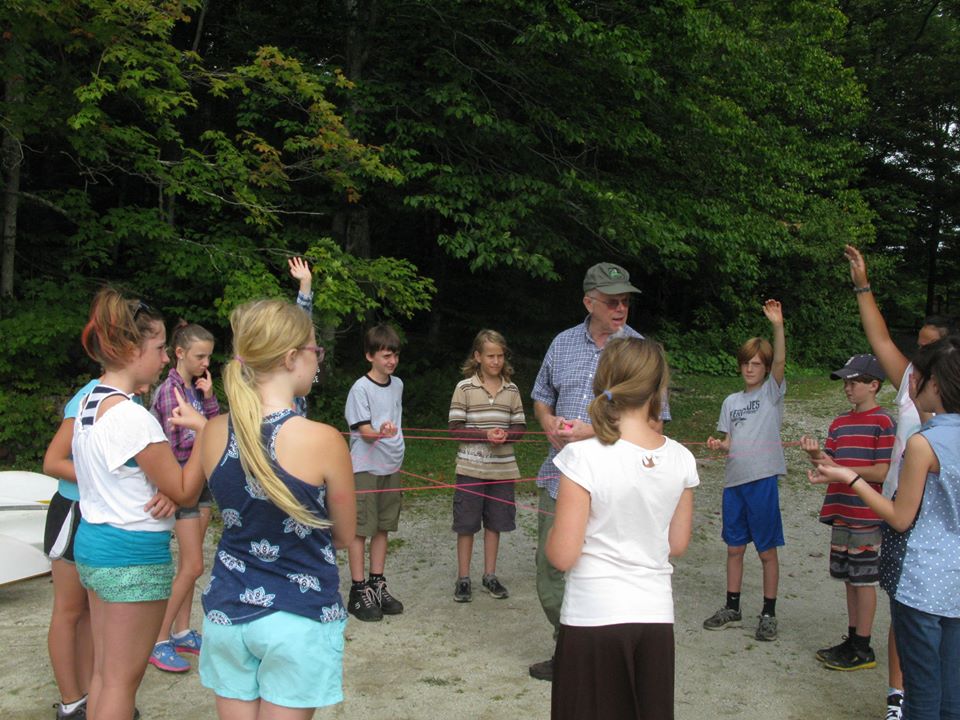
“the web of life” Woodford State Park photo: P’tricia Wyse
Carol Berner, who serves on the faculty at Smith and Antioch colleges in the education department, recently had the opportunity to work closely with David in her role as Regional Coordinator of River of Words. She joined David and his students at Hogback Mountain:
On this first encounter I was struck by the intensity with which David’s students were immersed in their nature study. They were proud of their plots, skilled at observing, respectful of each other and nature, familiar with the names of particular mosses and trees and welcoming of a newcomer.
Through sustained focus on a particular place, over time, and with expert guidance students discover that learning takes time and happens in community – not only the community of the classroom but also of the forest. These 5th-6th graders entered into a relationship with their study plot that taught them how to observe, imagine and articulate interconnectedness with the world. We all learned how to “think deeper” and “look at things in different ways.” The magic of this kind of learning is captured in one boy’s concluding reflection: “And it was peaceful.”
A sense of belonging lies at the heart of David’s approach to teaching and learning.
In his remarks to the Council, David touched on the importance of place-based education:
In addition to deep, active learning, field work instills in students a sense of place. Meaningful interactions with a location and a subject matter and work within a community engenders in all of us a sense of belonging, of connection.
Local interviews
In her recommendation to the Council, Principal Francie Marbury highlighted David’s community history project, Work in Marlboro:
Over the course of several years David’s students have interviewed Marlborians who live and work in town. These interviews are archived digitally with the Marlboro Historical Society and create a rich record of this eclectic and colorful community. Interviewees have included the road foreman, artists, college professors, builders, bus drivers, and town officers.
“Teachers like Swenson Award Educator David Holzapfel are our civic heroes,” writes VHC Executive Director Peter Gilbert. “The influence of such teachers on their students never ends,”
Principal Francie Marbury echoed this praise in her recommendation with this quintessential anecdote about the lasting effect David has on his students:
Imagine – school is out for the day and all is quiet as a lanky adolescent walks purposefully down the hall and up the stairs to David’s room. He’s come to check in, fill David in on high school life, and reminisce about his 6th grade field research trip to New York City.
David’s high expectations for his students, his wry sense of humor, and his passion for the material he teaches result in his being the teacher students remember long after they leave Marlboro School.
In his remarks to the Council, David credited his Alma Mater, Marlboro College, for teaching him “that sustained focus in an area of study broadens and deepens the pleasures of learning.”
It is this dedication and delight I strive to impart to my students.
David Holzapfel, captured by a student, Cape Cod Field Research trip
(Note: David Holzpfel began teaching a Marlboro Elementary School in 1990. He’ll retire this June after 25 years in the classroom.)
(this article was first published in The Cracker Barrel, Deerfield Valley News Winter/Spring edition, 2015. Thank you to the The Commons, Brattleboro, VT for sharing photo/text.)
Our oldest’s birthday has always marked the shift in seasons.
The rain comes, as it did yesterday, and then suddenly autumn whispers.
The breeze at the pond is too much for adults to swim, and the boys fall asleep earlier than they have all summer.
My husband and I finish a movie before 10, and after we turn off the tv, we notice light falling across our just finished floors.
Out the kitchen window, we spy the moon, perched between the evergreens–our trees–out our window.
We closed on the house today… and it seems to us that the moon is offering her approval.
Casey steps out on the porch–something he’s always dreamed of–and I join him there to say goodnight to the stars in the silent sky.
Just then, music comes screaming across the pond…
“I believe in miracles, since you came along, you sexy thing, you sexy thing…”
(We built our home on the same dirt road as a summer camp.)
I want to resent this intrusion, this robbery of perfection, but I always liked that song, sang it all the way down to Key West when I was 12.
There’s something funny about disco music playing across from our home in the woods. Serenity and dancing. The sublime and the mundane. It fits our family. Reminding us that miracles abound.
Twenty years later and Vermont is still giving me warm fuzzies for things I didn’t even know I cared about–like politics or energy or something called a “heifer.”
Last month at the River Garden was just one of those times. Students from area schools gathered for a mid-point check in on their science projects for the upcoming Neighborhood Energy Science Fair, sponsored by the Strolling of the Heifers.*
Executive Director Orly Munzing addressing students.
Executive Director Orly Munzing, who founded the Strolling, was on site to address the participants as they prepared to have their work reviewed by science professionals. She told these young innovators that their passion for energy science would help define the future of this planet, and as such, they would serve as ambassadors–educating others, even adults, especially adults. (I got chills.)
I’m only just beginning to comprehend the full scope of what has transformed (in my mind) from a novelty parade into a movement, experienced closeup through my children, who insisted on going to that first “cow” parade in 2002.
A decade later, one of those children is among those enthusiastically preparing an entry for the science fair.
My son Aidan, 13, has been working with peers, Leander, 12, and Cyrus, 10, on a project they began shaping last winter at their elementary school. After School Program Coordinator Emily Wagner worked with regional educator Lisa Holderness from the Vermont Energy Education Program*(VEEP) to engage students who were interested in energy science and who might like participate in the Strolling’s Neighborhood Science Fair which they were helping to sponsor.
It’s exactly these kind of opportunities that create the warm fuzzy feeling that Vermont so freely offers; and its the conscious connections behind those fuzzies, so richly interwoven, that make it hard to know who to thank for making Vermont such a caring place.
But I’d like to try, simply as an exercise in appreciation and recognition:
Was it the Strolling of the Heifer Parade, and the accompanying events that ignited an interest in sustainable energy for my son? Was it the after school science programs, partially funded by the VT Agency of Education, that flamed that interest? Was it his teachers at Marlboro Elementary who, year after year, emphasized experiential, place-based education, capped by independent research, followed by field study abroad and at the Nation’s Capitol with opportunities for social activism? Was it the accessibility of government officials, like VT Governor Peter Shumlin and Senator Bernie Sanders, which so empowered him? Was it our neighbor, Gary MacArthur, who installed our hot water solar panels? Or was it my husband and our community who raised the energy-efficient home in which we live? Was it our grocery store–The Brattleboro Food Co-op whose mission includes outreach and education–connecting food, people and place? Was it the unique community of Brattleboro itself, known for its activism, art and engagement and the enthusiastic support of that by local businesses? Or was it something even simpler, like the hatching project in my son’s kindergarten classroom, or the visit to the local farm in first and second grade, or the creation of the school garden in third and fourth grade–each supported along the way by educational grants from the Strolling of the Heifers?
You’ll have to ask Aidan and his friends, Leander and Cyrus, why they devoted week after week of their free time to a project that even their parents don’t fully comprehend. You’ll find them Saturday, after the parade, on the Brattleboro Commons, as part of the Slow Living Expo, at the center of the Home Energy Village where the first annual Neighborhood Energy Science Fair takes place!
~kelly salasin
Students meet with science professionals at the River Garden in May.
*Now in its second decade,the Strolling of the Heifershas grown from a small-town parade (of cows) into a regional movement with year-round programs and events. The Stroll has expanded its horizons to include not only sustainable agriculture and food systems, but other aspects of local economic sustainability, highlighted by a three-day Slow Living Summitwhich opens tomorrow, June 4th, 2014. The parade and fairgrounds take place on Saturday, June 7th.
VEEP (Vermont Energy Education Program) is one of the sponsors of The Neighborhood Science Fair. Founded in 1979, their mission is to cultivate energy literacy among Vermont students. “Students who understand energy and how it works will make more informed choices about energy use and inspire others to do the same.”
An Energy Literate Person Knows:
What our energy resources are and how we utilize them
The many ways electricity is made and the advantages and disadvantages of each
Why it is important to use energy wisely and how to do so
How government policy effects our energy choices
An Energy Literate Person Chooses:
To use energy wisely, recognizing the impact of their choice on climate change, our environment and our economy
To share their knowledge and inspire action and learning in others
To schedule a free in-class presentation, or learn more about VEEP’s standards-based curricula and ‘hands-on’ science methods, visit www.veep.org.








 science programs, partially funded by the


 This Vermont Life