Solar Hill gardens, Kelly Salasin, 2011, all rights reserved
When I first moved to Vermont, 18 years ago, I heard about Scott Willis, and a place called Solar Hill, I just never knew where it was. When I finally did meet Scott, just a few years back, he wasn’t what I expected.
The name “Scott” brought to mind a youthful, blonde-haired, tennis player, and maybe he was at one time, but now he was a middle-aged guy with a softer figure and a touch of grey. Just my kind of guru.
When he opened my first yoga class with Stevie Ray Vaughan, I was hooked; and when he tossed out a few bad jokes, I knew I’d found what I was looking for.
It wasn’t too long before I felt the yearning to become a yoga teacher myself, only I knew that my tight muscled, low-keyed body couldn’t handle the intensity of some of the typical trainings. “I wish Scott would offer a yoga teacher training,” I said to my husband.
And then he did.
In 2011, Scott began Hits the Spot Yoga Teacher Training, a year-long program that takes place one weekend a month. That first class filled up before I could get on the list, but I signed on well in advance for the 2012 program.
I am both excited and anxious. Anxious for all the reasons I’ve already covered–tight muscles, lack of ability or inclination toward physical exertion; those kind of things. Fortunately, what I look forward to outweighs my fears.
I look forward to the challenge of deepening into the body and out of the mind. I look forward to the challenge of learning basic anatomy–if nothing else than to develop a greater appreciation for the gift of this miraculous instrument we call the body. I look forward to the way the training would seep into my every day life and out into my overall outlook and presence. I look forward to expanding my platform as a teacher and group leader.
Despite all this looking forward, I’m still afraid, but I’m counting on some bad jokes and some good tunes to ease the way.
Occupy Brattleboro, October 15, 2011, Kelly Salasin
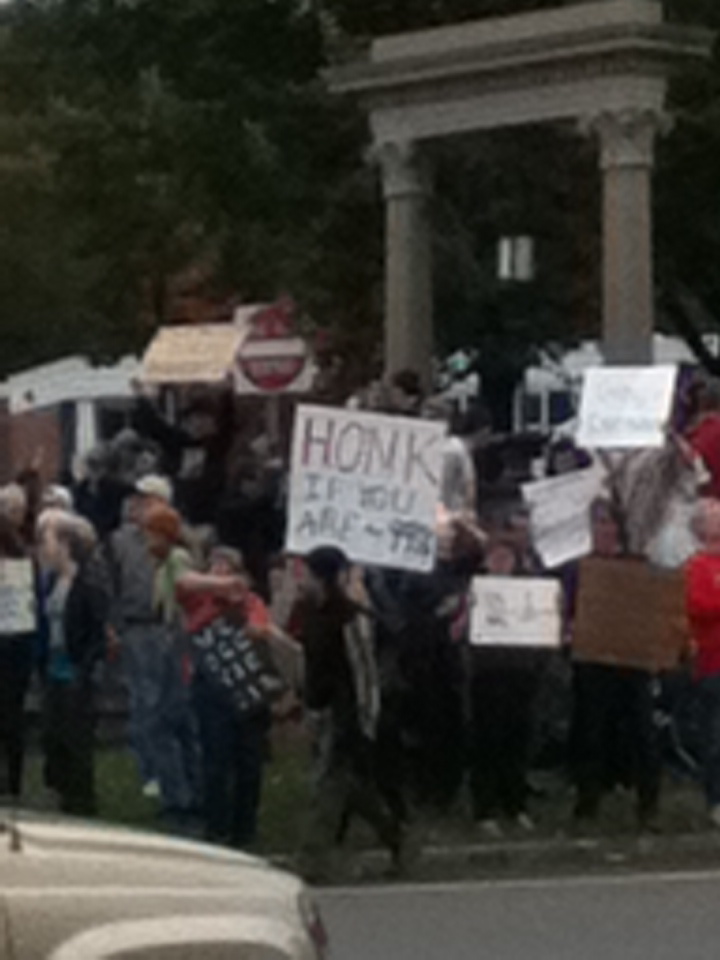
On Saturday I joined the Occupy Movement in the comfort of my own town park in Brattleboro, Vermont. “What are we doing here?” my eleven-year old asked, “This isn’t Wall Street.”
I explained that this was our way of showing our support for what started in NYC. My son looked around the small park and noticed his school nurse, some younger classmates, and our neighbors from up the road. I introduced him to the midwife who assisted us with his older brother’s birth. “Helena came from across the state to be here,” I said, as she and I shared a sweet embrace.
Some of our South Pond friends were gathered too. Sparrow was there with her new baby, and Ted and his wife were there with their colleague from Nicaragua. Charlie and Kate told us that both of their sons, in different parts of the country, were gathering today. Students and teaching colleagues of my husband were also well represented.
“There are Occupy Movements in Rome and London this weekend as well,” he added.
“They’re happening over the world,” Kate echoed.
While we talked, young people led chants, while others of all ages stood by the road with signs. The thumbs up and solidarity honking was non-stop. People rolled down their windows to cheer. A local lawyer. Truck drivers. Teenagers. Old guys. BMW’s. Beaters. Delivery vans. NY plates, Connecticut, Pennsylvania, Massachusetts.
After an hour, my son walked into town to spend his pocket change, while my husband and I occupied a blanket apart from the crowd. A man from New Hampshire dropped down beside us, saying that he needed to soak up my “peace” vibe. I chuckled to myself, imagining an entire movement of people lying in the grass under the sun.
This guy had been in Boston for the rallies there, where it was much more intense, and he said that he preferred the energy here. After a few moments of silence, he was up again, off to talk with Health Care activists and 350-ers and some young men shouting about Ron Paul.
“If Ron Paul were running this country, those kids would never have gotten to this rally,” my husband said. “Our roads would still be missing.”
After 3 hours, I was ready to go. I wanted to get a bite to eat before the literary event with Ken Burns and David Blistein at the museum. There was no specific mention of Occupy Brattleboro at this large gathering, not even by the local organizer, but she did reference the fire and the floods and the murders. I appreciated that.
I also appreciated Ken’s message that we have to see ourselves in each other, that it’s our arrogance that makes us think that our views are uniquely right or that our times are special or that we are living our lives more fully than the generations before us. We each have our individual stories, he said; we each contain generosity and greed, sincerity and hypocrisy.
His friend David Blistein echoed these thoughts, saying that our righteousness prevented us from truly “feeling” our history, or seeing the other side. It doesn’t allow something new to happen, he said.
I couldn’t wait to get into the discussion during the Q& A, but there was more. David read from his new book, Real Time, with the voice of Harriet Tubman who had this to say to our self-absorbed generation:
At least those people knew they were slaves… (unlike the)people in the so-called ‘free’ world today. Because they plainly are not aware of their chains… Getting up at dawn to travel in a little metal box just so you can spend the whole day in another little box? That’s slavery. Having to look at the words on your computer before even saying hello to your children? That’s slavery. Sitting in front of your TV for hours at a time? That’s slavery. Thinking that the wealth in your bank account is more important than the wealth in your heart. That’s slavery. Living with a husband or wife whom you’ve forgotten how to love. That’s slavery.
It occurred to me that although “our times” seem so divided and alternately so “enlightened,” there is an arrogance in distinguishing ourselves from the past. It’s what Ken Burn’s calls, “the tyranny of the present.” But I didn’t whole-heartedly agree with either man’s view, and so when it was time, I shot my hand into the air.
“As a memoirist,” I said, “I do see the same history repeat itself in my family with the most uncanny details; But I’ve also seen it evolve. Each generation may pick up the same story, but they also make it a little better. I see the same evolution with Occupy Wall Street. They’ve created the space for something new to emerge–from the people.”
I could have wrestled these thoughts into the wee hours of the night with these two, but hundreds of people were ready to descend upon them, and I had a husband waiting across town with a glass of chardonnay and a late night burger.
It had been a good day in Brattleboro, made up of everything I love and admired about her. She had survived the fire, the murders, the floods and was still doing what she does best–engaging people in what matters to them.
It wasn’t just the Literary Festival, or the Occupation at Wells Fountain Park. It was the general hum of the town–among the staff behind the Co-op’s deli line or Amy’s bakery; in the arm chairs of the library; on the lawn of Brattleboro Savings and Loan with Fish from WKVT; at the newly restored Latchis with the broken marquee, still offering up opera and jazz; and down the street at the youth theater (NEYT) exploring homophobia with their latest play.
Past, present and future, the people in Brattleboro examine the chains, on all of us, and creatively endeavor to sing and read and gather to set us free.
(p.s. sometimes I think a little arrogance is in order to claim the change we want to see, especially if when its balanced by compassion and humility in the face of so much pain.)
Kelly Salasin, October 2011
The previous post on the Occupy Movement was: Occupy WHAT?
In the days and weeks following the Co-op tragedy, I’ve wondered, What is Richard doing?
I’ve never been imprisoned or even spent a night in jail so I have a hard time imagining how Richard’s hours are shaped–beyond the stark horror of his act.
How does he sit there, day after day, staring at such devastation? How does he read a book or write a letter or take a breath–apart from it?
Does the murder hit him like icy water when he wakes each morning?
Is the pain as sharp as it is for Michael Martin’s wife?
How does Richard find permission to move on?
What does he say to his wife when she visits?
How about his mother?
His best friend?
His co-workers?
Other prisoners?
“I shot my boss in the head.”
What do they say in return?
Does he make friends? Does he try something new? Does he begin to heal despite the never-ending pain of his crime?
Over two months have passed since Richard entered the Co-op that Tuesday morning with a gun.
How is everyone else doing now that the shock has worn off?
Does the icy water of remembrance hit you in the face from time to time too? Like when you’re standing outside of Sam’s flood sale on Flat Street and glance across the brook to see the Co-op’s loading dock? Or when you’re pushing your cart toward the yogurt and have to pass the opening for the back offices?
Although this is my designated week “unplugged,“ I’m making an exception to participate in the 5th Annual Blog Action Day. I’m proud to say that this is my third year joining bloggers around the world in posting about the same issue on the same day.
I was a brand new baby blogger the year I wrote about “Climate Change”–a steep topic for someone without a science brain; while last year’s focus on”Water” flowed more easily; and this year’s topic”Food” taps my roots–in Vermont.
I remember the first time I set foot in the Co-op. My doctor made me do it. I tentatively strolled down each unfamiliar aisle, past all the unfamiliar packaging–no Kellogs or Kraft or Keebler. Worst of all, some of the food had scary labels, saying: “organic.”
I skipped over those items.
Eventually, the Co-op became part of my shopping routine, and soon after, I became a member. Over the years, I watched as more and more items were labeled organic–and later “local”–and slowly it all began to make sense. In this way, the Co-op taught me about food and about the connection between my purchases and my health and the wellbeing of the land and the water and the air.
That journey began 17 years ago. I’ve had two sons since and they’ve grown up in the Co-op. They’ve helped stock shelves and served food at fairs and have organically learned about the relationship between what we eat and how we grow it and how that shapes the world around us.
It was my cousin out in California who brought it all together for me. She told me that her water was polluted because of all the pesticides used on grapes, and after that “organic” became personal. Each time I picked up a bottle of wine, I thought about Deborah, and how my choice, 3,000 miles away, affected her life in such a vital way.
I am a Virginia National Guard soldier. I have been in Vermont for three weeks. I have driven hundreds of miles through your state and seen first-hand the devastation caused by Tropical Storm Irene.
First off, my condolences go out to all those affected by the storm. But what affected me most were the people. From the first day and… the first plate of brownies, the local community has been so supportive, thankful and generous that we were all in awe. We are accustomed to “Southern hospitality,” but the people of Vermont have taken it to a new level. Everywhere we go the locals stop and thank us, but I really just want to thank you.
This gratitude goes out to the hundreds of thumbs-up we have received, and especially the little girl who gave me that great smile at a stoplight and a little boy that hugged one of our guys and said, “Thank you, Army man.”
To the people at the Spartan Arena that graciously allowed us lodging and the servers at the Armed Forces Reserve Center that fed us morning and evening meals, we thank you. To Mark, Jen, Tim and the rest of the volunteers, we thank you. For all the plates of cookies, brownies and boxes of personal items — and those tasty Vermont apples — we thank you.
But most of all, thank you, Vermont, for showing how people can pull together in times of need. You were all so generous, gracious and hospitable. I can only hope that if this ever happens in Virginia, or anywhere else in this great country, the people would act the same way. When I leave here in a few days, I will take with me a piece of Vermont and know that Vermont will be just fine thanks to her people.







 This Vermont Life