Rolling Stone No More

Rolling Stone No More

While snuggling in bed beside my husband, I spring up with a realization.

“I think this is our 7th Christmas.”

“Not yet,” my husband says, counting on his fingers.  It’s easy for him to know from when to begin: 2004, and the 48 hour Christmas.

“You’re right,” he says, “It is 7.”

“You know how significant this is,” I say.

“Yes–And it’s the house ‘I’ built.”

7 years ago this December, Casey and I lived apart for the first time in 20 years. That November the boys and I moved to my sister’s in Florida so that he could devote every waking (and barely-waking) hour to finishing this house in time for Christmas (since he already missed Labor Day, Halloween and Thanksgiving.)

At midnight on December 22, he picked us up at the airport and we moved into our home–the first home that we have ever owned.

“This will be the house that I’ve lived in the longest,” I say, as I roll over to turn off the lamp at my bedside.

“And it’s the house ‘I’ built,” he says again, rolling to turn off his own lap.

We almost didn’t make it to 7 years. Back in 2008 when Casey was unemployed, he looked at some international teaching jobs–a prospect which was thrilling to me–but meant that I’d  have to start over from scratch on the 7 year thing.

“I haven’t made it yet,” I say, settling back down into Casey’s arms. “It’s not Christmas yet, and I could die or the house could burn down or something.”

“Don’t say that kind of stuff,” Casey says, pushing me away.

The truth is that this is such an important milestone to me that I’m anxious about it. I felt this same fearful uncertainty before I left for England in my junior year, and then again before our first baby was born.

Sometimes the things we really want seem that impossible, especially when they’re so close to coming true.

I remember when Casey reached the 7 year mark with me. It was an important finish line for him–it meant he surpassed my first love. Though he’s now more than tripled that number, he still reminds me of his longevity–“Almost 4 times as long,” he says.

First love, first son, first house. They’re all so significant.

I don’t know what number home this is for me. I’d rather not count. As an Army brat who was born while her dad was still in college, I’ve had my share of moves and homes and schools

My own boys were born and raised in this same small town, attended the same small school, and grew up with the same kids that they played with at preschool. I was 14 when my parents finally settled down in one place.

That home had been the one that belonged to my grandparents, my beloved “6012.” But our time there was short. My parents divorced, and not only did we lose our family, but our home.

After that, I went to Europe three times, lived out West, moved back home, and then took off for these Green Mountains.

Our first place in Vermont was a tiny farm-house nestled beside a “babbling” brook, and seated at the foot of a mountain beside the National Forest. Both my boys were conceived there, and for seven years, it was our “home sweet home.”

When we left that rental, it was heartbreaking, but the time had come for us to set out on our own, and a few moves later, we were here–in the house that Casey built–with the help of his boys and all of our friends.

7 years ago this Christmas.

(Did I count right?)

Kelly Salasin, December 2011

The Road Half Taken

The Road Half Taken

Route 9, after Irene; Marlboro, VT; Kelly Salasin, all rights reserved

Yesterday I drove down my hobbled road, snow encrusted, and turned onto Route 9 for the morning commute to Brattleboro–and didn’t give it a second thought when the flow of traffic stopped, and became single lane, as if it was as natural an occurrence as the mindless speed.

I was surprised to find myself relieved rather than annoyed by the delay.

“They haven’t abandoned us,”  I said to my empty car.

In this post-Irene world, road work had become the norm, and we’ve appreciated every moment of it; but then they were gone, leaving our roads were delightfully “passable,” and eerily unfinished.

Last week over a foot of snow arrived before the plow poles were anchored along the dirt roads or the guard rails finished on Route 9.

I don’t need to explain the significance of guard rails, but here’s the thing about plow poles–they show us where there is and isn’t a road.  When everything is white, it’s hard to tell, particularly when what was once road, no longer is, because it was half-eaten away by water, and restored, but never fully so.

The lower half of my road is one of those. A few weeks back when they put in the temporary bridge at Neringa, someone dropped a lot of rubble on the sides of MacArthur so that the truck filled with dirt could  make it to the site without toppling over. I bet the rubble is fun in a truck. Not so much in a Honda Civic.

When I can’t stomach the bumps, I take the back way to Brattleboro. It’s all dirt, and it’s slower, but it’s predictable, though the potholes are propagating and the ruts where one road meets another are deepening.

Though it’s been two months since Irene, I find myself having flashbacks on this particular day–hauntings from the night we drove home after the flood.

I can see the ghost of a car dangling into a crater near Robb Family Farm. I can see Ames Hill strewn with rocks. I can feel the fear that we might not make it.

So many roads were taken by Irene and so many still hobble. Some friends have only just had their roads repaired, while others have had repairs washed away by the rain. Stopping for a work crew, in the middle of the morning commute, is a comfort now instead of an annoyance; something I once took for granted; like the permanence of highways and country roads.

Kelly Salasin, November 2011

For more on Irene & Vermont roads, click here.

Turn On

Turn On

Autumn Snow, Shannon Albritton, all rights reserved, 2011

It’s a quintessential Vermont day, and we’re all trying to hold onto the last breaths of autumn before the big snow. The vendors at the farmers market are shivering, but they’re also grinning.  The market closes today–for the season. No more waking at dawn to make egg rolls or harvest vegetables. They’ve shown up for us for the past 6 months, and now they’ll pack it up until spring comes round again.

Like a party crasher–with guests–snow is the forecast, and not just flurries. A foot. Facebook posts prematurely turn toward woodstoves and woolens, muffins and hot soup. The bloggers are stirring too. Three neighbors post at once. Jodi, about our road. Shannon, about the weather. Kevin, about… taking a dump.

To tell the truth, I’m not sure what Kevin’s post is about, and I’m not even sure I’m supposed to blow his cover. This is the first that Nature Man has “blogged” if I’m not mistaken. Mostly, he just spouts. Vitriol. Like this:

I was takin a dump the other morning while the wife had the National Pompous Radio on in the kitchen. I know, I should have got up and shut the door to the shitter, but I was mid-turd, so I had to sit there listening to them blather. They were interviewing some fellow who was a leader of something called the Tea Party. He was talkin all tough about cutting taxes and job creators and Cripes knows what else, and all I’m thinkin is, buddy, you named your group after something my daughter does with a stuffed bear and a headless Barbie doll.

Natureman suggests a KEG PARTY instead; which is where I need to be in 30 minutes. Actually it’s a cider-pressing, but there’s always beer. Do you think it’s still on? The white stuff has begun to fall.

After 18 years in these Green Mountains, summer is by far my favorite season; but when the snow comes around, like an old lover, it doesn’t matter how many times he’s been dumped, he stills turns me on.

Kelly Salasin, first snow, 2011

The “W” Word

The “W” Word

open clip art.com

It is time to “put the padlock on the gate” says the notice to members of South Pond, the timeless gathering place of summer.

This is crushing news to those of us who hold onto the sun until the ice freezes our fingers, and releases them, frost by frost, until we have lost our grip on summer, and even fall.

Today’s was a hard frost, but at least the sun is shining. Yesterday, when it was mostly grey, I saw my body flinging itself off a cliff over and over again. Luckily I was in my bed, under the covers, with a novel, ignoring the coming gloom of November.

In the evening, a friend invited us to gather around a fire in the woods behind her home. I didn’t want to. I didn’t want to do anything. But I did, and I was a better for it.

As the first star pieced the sky, I soaked up as much yellow and orange and red as I could from the flames inside her pit. This is our way of capturing the sun, I thought.  This is our way of making it ours, until it returns again to wake the world in tender greens.

Snow is the forecast this week. Snow.  There. I said it. The “S” word. (But I refuse to say the “W” word–no matter what the forecast.)

As a Vermonter of 18 years, I accept snow around Halloween, although I welcome a balmy night on which to Trick or Treat. Either is possible this time of year, as the Earth begins to rock us toward the “W” word– into that long, white slumber of deep.

Kelly Salasin, Marlboro, VT

Occupy Brattleboro

Occupy Brattleboro

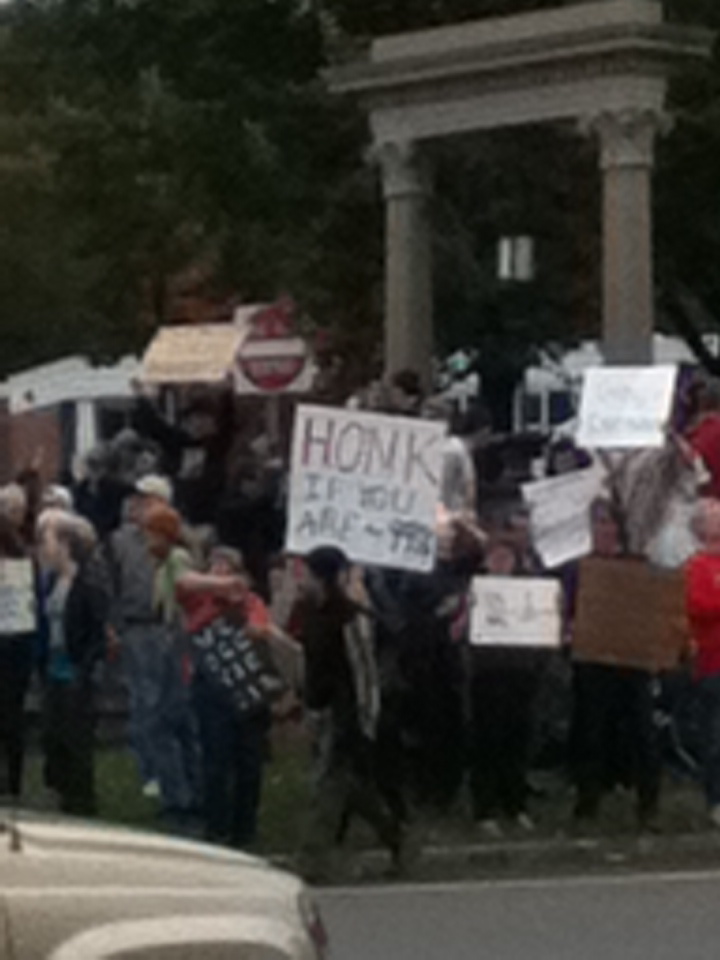
Occupy Brattleboro, October 15, 2011, Kelly Salasin

On Saturday I joined the Occupy Movement in the comfort of my own town park in Brattleboro, Vermont. “What are we doing here?” my eleven-year old asked, “This isn’t Wall Street.”

I explained that this was our way of showing our support for what started in NYC. My son looked around the small park and noticed his school nurse, some younger classmates, and our neighbors from up the road. I introduced him to the midwife who assisted us with his older brother’s birth. “Helena came from across the state to be here,” I said, as she and I shared a sweet embrace.

Some of our South Pond friends were gathered too. Sparrow was there with her new baby, and Ted and his wife were there with their colleague from Nicaragua. Charlie and Kate told us that both of their sons, in different parts of the country, were gathering today. Students and teaching colleagues of my husband were also well represented.

“There are Occupy Movements in Rome and London this weekend as well,” he added.

“They’re happening over the world,” Kate echoed.

While we talked, young people led chants, while others of all ages stood by the road with signs. The thumbs up and solidarity honking was non-stop. People rolled down their windows to cheer. A local lawyer. Truck drivers. Teenagers. Old guys. BMW’s. Beaters. Delivery vans. NY plates, Connecticut, Pennsylvania, Massachusetts.

After an hour, my son walked into town to spend his pocket change, while my husband and I occupied a blanket apart from the crowd. A man from New Hampshire dropped down beside us, saying that he needed to soak up my “peace” vibe.  I chuckled to myself, imagining an entire movement of people lying in the grass under the sun.

This guy had been in Boston for the rallies there, where it was much more intense, and he said that he preferred the energy here. After a few moments of silence, he was up again, off to talk with Health Care activists and 350-ers and some young men shouting about Ron Paul.

“If Ron Paul were running this country, those kids would never have gotten to this rally,” my husband said. “Our roads would still be missing.

After 3 hours, I was ready to go. I wanted to get a bite to eat before the literary event with Ken Burns and David Blistein at the museum. There was no specific mention of Occupy Brattleboro at this large gathering, not even by the local organizer, but she did reference the fire and the floods and the murders. I appreciated that.

I also appreciated Ken’s message that we have to see ourselves in each other, that it’s our arrogance that makes us think that our views are uniquely right or that our times are special or that we are living our lives more fully than the generations before us.  We each have our individual stories, he said; we each contain generosity and greed, sincerity and hypocrisy.

His friend David Blistein echoed these thoughts, saying that our righteousness prevented us from truly “feeling” our history, or seeing the other side. It doesn’t allow something new to happen, he said.

I couldn’t wait to get into the discussion during the Q& A, but there was more. David read from his new book, Real Time, with the voice of Harriet Tubman who had this to say to our self-absorbed generation:

At least those people knew they were slaves… (unlike the)people in the so-called ‘free’
world today. Because they plainly are not aware of their chains…
 Getting up at dawn to travel in a little metal box just so you  can spend the whole day in another little box? That’s slavery. Having to look at the words on your computer before even saying hello to your children? That’s slavery. Sitting in front of your TV for hours at a time? That’s slavery. Thinking that the wealth in your bank account is more important than the wealth in your heart. That’s slavery. Living with a husband or wife whom you’ve forgotten how to love. That’s slavery.

It occurred to me that although “our times” seem so divided and alternately so “enlightened,” there is an arrogance in distinguishing ourselves from the past.  It’s what Ken Burn’s calls, “the tyranny of the present.” But I didn’t whole-heartedly agree with either man’s view, and so when it was time, I shot my hand into the air.

“As a memoirist,” I said,  “I do see the same history repeat itself in my family with the most uncanny details; But I’ve also seen it evolve. Each generation may pick up the same story, but they also make it a little better. I see the same evolution with Occupy Wall Street.  They’ve created the space for something new to emerge–from the people.”

I could have wrestled these thoughts into the wee hours of the night with these two, but hundreds of people were ready to descend upon them, and I had a husband waiting across town with a glass of chardonnay and a late night burger.

It had been a good day in Brattleboro, made up of everything I love and admired about her.  She had survived the fire, the murders, the floods and was still doing what she does best–engaging people in what matters to them.

It wasn’t just the Literary Festival, or the Occupation at Wells Fountain Park. It was the general hum of the town–among the staff behind the Co-op’s deli line or Amy’s bakery; in the arm chairs of the library; on the lawn of Brattleboro Savings and Loan with Fish from WKVT; at the newly restored Latchis with the broken marquee, still offering up opera and jazz; and down the street at the youth theater (NEYT) exploring homophobia with their  latest play.

Past, present and future, the people in Brattleboro examine the chains, on all of us, and creatively endeavor to sing and read and gather to set us free.

(p.s. sometimes I think a little arrogance is in order to claim the change we want to see, especially if when its balanced by compassion and humility in the face of so much pain.)

Kelly Salasin, October 2011

The previous post on the Occupy Movement was: Occupy WHAT?