Farewell Brattleboro Co-op

Farewell Brattleboro Co-op

Minutes before the old Co-op closes its doors for the last time.                                June 14, 2012.     6:40 pm.

I walked through the Co-op tonight for the last time. They’ve started moving without me. We never picked up our mail at the post office this month so we only just discovered that they were closing today at 7:00 pm. For good.

Apparently, they had already moved quite a bit. Every dry good aisle was empty, and it was only the refrigerator and freezer cases that remained stocked. There was a make shift counter in the deli and there we ordered a sandwich in a wrap because there was no more bread. There were no chips either. Except for bags and bags of mesquite bbq ones which obviously need to be discontinued.

We ate our dinner on one of the benches facing the new store in the soft evening sun of early summer. We watched John Hatton, President of the Board, walk back and forth from the old store to the new store and then across the bridge toward Dotties.

Ah, Dotties. That’s the same.

But then again, it isn’t. It hasn’t been around that long. It’s a spring chicken as far as the Co-op goes.

After finishing our wraps, we went to a fabulous movie about aging and India and love and growth. My heart was overflowing by the time it was over, and the new bathroom at Latchis took me by surprise, even though it’s been renovated for quite awhile now.

I miss the old narrow entrance and tight corners of the wooden stalls and tiny porcelain sink. It was terribly impractical and very charming.

I’m getting old. Not quite as old as the brilliant characters in the film, but I’ve been in Vermont long enough to see things really change. Like the Co-op. It’s grown three times since I first started shopping there–almost 20 years ago.

Twenty years! How did that happen?

When I arrived in the Green Mountains from the Jersey Shore, I wasn’t even 30. Since then I’ve watched young children become mothers, and middle-aged friends become elders. I’ve lost some too.

It’s not that I’m nostalgic. I love change. I can’t wait to enjoy the new store. Good riddance to those grimy bathrooms and that over-seated cafe.

And yet, in the passing of the Co-op, and that of old friends, I can feel my own self slipping away. I’m part of all that is passing–because it was once a part of me.

Kelly Salasin, June 2012
2012 Vermont State Ultimate Championships

2012 Vermont State Ultimate Championships

Lyndon Institute, Northeast Kingdom

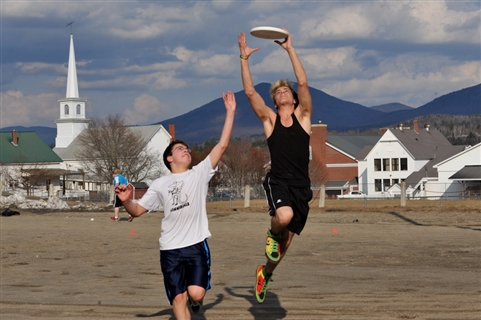
Okay, I was wrong. Frisbee players aren’t all pot-smoking loafers. In fact, when the family and I took the long drive up to the Northeast Kingdom to check out the Vermont State Championships, we were delighted by the positive energy on the field.

Ultimate Tournament Staff delivering water

Actually, there were surprisingly several fields–upon which several teams played at once–each with its own entourage of tents and coolers and water jugs and nomadic fans–who packed up the belongings and moved at the end of each game , like a caravan through the desert, though this was the lush, green hills of the northernmost part of the state, approaching the Canadien border.

Who knew there were so many highschool Ultimate Frisbee teams in Vermont–28 represented today!  What struck me most about this spectacularly coordinated event was the air of festivity–as evidenced in the joviality of the players–with cheers and antics and most notably–song. Teams actually sang to one another. It was a bit like Monty Python meets Morris Ale meets the pasture–rolling hills and fence posts and the like.

That said, the team playing against our own Brattleboro Honey Badgers was–intense–with several highschool-aged coaches & the like about to burst an artery–while screaming at their own players. Not only did they lose, by quite a bit, but they got a zero from our team for “Spirit”–on a scale of 1 to 5.

Honey Badger Spirit

Yes, there was actually a score for “Spirit,” which provided yet another facet to appreciate about this sport that I had once pooh-poohed. In fact, each team was to assign a “Spirit Captain” who was provided a special cap to identify him to others, as he was to receive “amnesty from coach-wrath when correcting a coach or team’s actions.”

The Captain’s role was to ensure that his own team was “playing fair, keeping language in check, not spiking the disc, and most importantly–not making calls from the sidelines.”

Alas, the Badger’s didn’t have an official coach, just one of their own players, and neither were they sanctioned or supported by their own highschool, though not for lack of trying. The kids did it all on their own under leadership of a couple determined seniors–scheduled practices, arranged fields, ordered uniforms, provided their own transportation to games and tournaments–like this one–a 4 and a half-hour round trip.

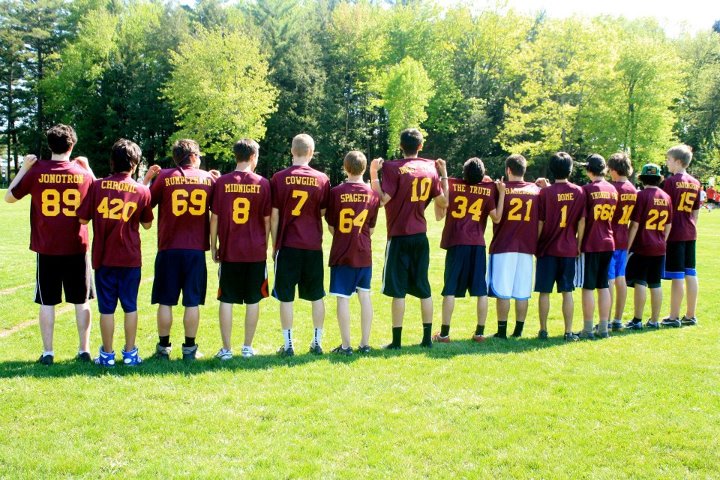
While at first the Honey Badgers were frustrated not to receive the same benefits that the football or the baseball or even the tennis players might ultimately, I think, they enjoyed their freedom. There were no eligibility requirements (like grades or behavior), or mandatory practices, and they had fun with their uniforms–choosing odd numbers (like 666) and odder names (like Midnight, Sauerkraut, Cowgirl and Spaghett.)

While the intensity of opposing team blew away any thoughts I had of frisbee as entirely laid-back,  there was a game going on behind us with another team from our neck of the woods–a private school known for independent thinking (and very limited competitiveness)–who could be overheard gently shouting, suggesting really, “Be aggressive,” as if they weren’t sure it was at all necessary (or possible.)

Our own team had a similar friendly edge, for when their game point was contested, they  eagerly acquiesced–just to be able to play a bit longer.  This afternoon in Lyndon, Vermont was the last time on the field for the seniors on the team,  and all of the Honey Badgers were eager to hold on to what they created together, with little acknowledgement to the day of wins.

Kelly Salasin, May 2012

Lyndon Center, Vermont

2012 USA Ultimate Vermont High School Ultimate Championships

The Evergreen

The Evergreen

We brought home the tree this past weekend–from the wind swept farm upon McKinley Hill in Jacksonville. I don’t know if it’s really called McKinley Hill, but those are the people for whom we remove our mittens to scribble stiffly: “twenty dollars and oo cents” in frozen ink each year.

We thought about waiting for more snow to lend more of the holiday feeling, but we opted for what we had, not knowing if the weather would offer more or take what little remains.

The sun was bright on the hill and the view spectacular, and so was the wind which made for little argument over which tree was best. (Even the new guy at the baler was surprised at how quickly we returned dragging a balsam behind us.)

It was such a tiny tree that it hardly needed shortening once home, but my husband took off a foot any way–with the chain saw–which my 16 year-old defended, “He’s a man. He has to use the most powerful tool available.”

At the farm, a simple hand-saw had been employed by our resident enthusiast: Eleven-year old Aidan who also pulled the tree carriage down the hill and just as enthusiastically dragged it back up while my husband loaded the evergreen onto our Civic.

I love seeing trees atop of cars. I like counting how many pass us in a day. This is not p.c. of me, I know; many of my rural friends feel compromised cutting down a Charlie Brown rut from their own woods, while others forgo the tradition altogether and hang ornaments from evergreen boughs.

This year I actually considered this, not with environmental consciousness, but with fatigue. I didn’t want to face the dramatic overhaul that is required in tiny living room to accommodate a tree; but this year’s choice was so trim–we only moved a single chair.

Our tradition is to leave the tree unadorned as long as possible to appreciate it for its simple gift of green.  Next we add the lights, and these too are left twinkling in solitude to inspire us on dark nights.

The last step is to add the ornaments, unwrapped from their boxes, labeled with dates and gift bearers, and carefully placed upon the boughs for the right effect of color, shape, medium and reflection.

We add egg nog and festive finger foods to this occasion, and then do the same with the holiday leftovers when it comes time to pack up the ornaments after the holiday.

The tree itself remains, lit and then unlit, until I can finally bear parting with the Balsam beauty in favor of order and an extra chair.

The Christmas tree is one of my favorite traditions along with the advent calendar and a daily reading from National Wildlife’s, December Treasury.  A tribute to the Evergreen is today’s offering:

Evergreen Reflection, Kelly Salasin, December 2011

The  Ancients

    One need not go into history to find the reasons for veneration of the evergreen tree or bough as part of the Christmas season.  They are of the enduring things of this earth, and man has known them as long as man has been here.  The pine, the spruce, the hemlock, the fir – all those conifers that know no leafless season – have been held in special favor when man would have symbols of life that outlast all winters.  And even more enduring, in geologic time, are the ground pine, the ground cedar, and the club mosses, most venerable of all the evergreens. 

    We gather them now, even as the ancients gathered them reaching for the reassurance of enduring green life at the time of the winter solstice.  For the pines and their whole family were old when the first man saw them.  Millions of years old, even, even at a time when millions of years had no meaning.  When we gather them we are reaching back, back into the deep recesses of time.   But, even as the ancients, we are reaching for reassurance, for the beauty of the living green but also for that green itself, the green of life that outlasts the gray winds, the white frosts, and the glittering snow of winter.

    So we bring in the pine, the spruce, the hemlock – and now, because of the cultivation of Christmas trees on a wide scale, we do so without desecrating the natural forest.  We bring the festoons of ground pine and partridgeberry, feeling a kinship with enduring things.  They help us to catch, if only briefly, that needed sense of hope and understandable eternity.

-Hal Borland