Kubler-Ross could not have imagined the grief over the inaccessibility of high speed internet in rural Vermont so she neglected to include the steps after Acceptance which are the ones I’m needing right now.
Following her landmark work on grief, two more stages have been slipped in by others: shock and testing.
But I’ve already done TESTING. I secretly glance up at the airport bar on my laptop every once and awhile on the off chance that I can catch myself already connected.
The other step, I’m saving. I’m saving SHOCK for the day when I actually have those grey bars filled in with black–from my own livingroom!
For now, I’m stuck in the VOID. Because the only other option is to cycle back through the steps–and I refuse to do that, no matter what Kubler-Ross says.
I’m sitting down on theses STEPS and waiting–practicing my best SHOCKed face so that the moment that WIFI arrives, it won’t know that what I really want to say is:
“All that summer Miss Rumphius, her pockets full of seeds, wandered over fields and headlands, sowing lupine seeds. She scattered seeds along the highways and down the country lanes. She flung handfuls of them around the schoolhouse and the back of the church. She tossed them into hollows and along stone walls…” (an excerpt from Miss Rumphius by Barbara Cooney)
~
If you are familiar with the story of Miss Rumphius, you might suspect that such a person lives among us in the Deerfield Valley. For a special someone must be tending to all the beautiful flowers about our town–the whites and pinks and purples that trail over the bridge and pour out of window boxes along Main Street, the lush geraniums and petunias bursting out of barrels in front of restaurants and shops.
Downtown Wilmington
Perhaps you’ve caught her, as I have, in the act of watering or planting or clipping. Maybe you’ve spotted her digging in the dirt at the cemetery on Stowe Hill at the end of the day. Or perhaps you’ve passed her, arms full of buckets and gardening tools, in front of Memorial Hall just as you were getting your first cup of coffee. Some days she seems to be everywhere… the Kreemee, Grand Union, the tennis courts and all along Route 100. Other days she can’t be found.
But she is there, somewhere, at work in her gardens. For she is The Flower Lady, and each one of those barrels and boxes and pots you see is a tiny garden that she has created.
Gardens, scholars say, are the first sign of commitment to a community. When people plant… they are saying, let’s stay here. And by their connection to the land, they are connected to one another. – Anne Raver
Mary Pike-Sprenger (aka. The FLower Lady) grew up on Shafter Street back in the days when Wilmington was a very popular summer resort:
“There was a whole different air to the town then. Visitors would come up from the city or Connecticut and stay for months. It was mostly older people, and they would sit and rock in these beautiful rocking chairs on the porch at Crafts Inn. In the evenings, they’d stroll around town and they’d always come down our street which wasn’t so commercial then.”
Mary’s grandmother, Meda Crafts, lived with Mary’s family, and she would start their garden every spring. Mrs. Crafts was friendly with the summer visitors who’d stop to admire her work.
“It was a wonderful garden,” recalls Mary fondly, “with these beautiful, vibrant blue delphiniums, orange oriental poppies, pink lupines… and a meticulously maintained white picket fence.”
Mary’s father, Gordon Pike, was a carpenter, and he built that fence himself. “It was handmade, piece by piece, gate by gate,” boasts Mary.
“We had a beautiful arbor with climbing roses over the top, and bird baths, and beds of daffodils… and I remember lots of wild yellow roses, and a lilly bed! My mother and grandmother did most of the planting and maintaining, but my brothers and my sister and I were expected to help out. (Have you ever dug up an iris bed?!) We did do a lot of complaining about the chores, but the garden was a real labor of love by all of us.”
The love of gardening is a seed that once sown never dies. – Gertrude Jekyll
“‘You must do something to make the world more beautiful,” said her grand father. ‘All right,’ said Alice. But she did not know what that could be.” (an excerpt from Miss Rumphius.)
~
It’s no surprise that the Pike children grew up to love gardening. Both Mary and her sister Melanie Boyd made it a large part of their lives as did their mother and grandmother before them. Melanie was the first to be hired by the town to plant and maintain flowers, while Mary began doing gardening work for the Red Mill where she works as a waitress. (Both sisters also work full-time as teachers.)
Later Melanie’s interests took a different turn and she began to focus mainly on private accounts, including gardening with Tasha Tudor. It was at that time that Mary took over the town job.
“My girls Tyne and Brie were very young and this type of work made it possible for me to be a mom, to be home a lot, or bring them along to help. We all love being outdoors too,“ says Mary.
“My days were shorter then, but things grew over the years. It was a phone call here, a phone call there or people would just see me working and ask if I could come take a look at their flowers. No matter how busy I was, I always seemed to say ’Yes’, but now I do have to think more about it because the job’s grown so much.”
As the Garden grows, so does the Gardener.
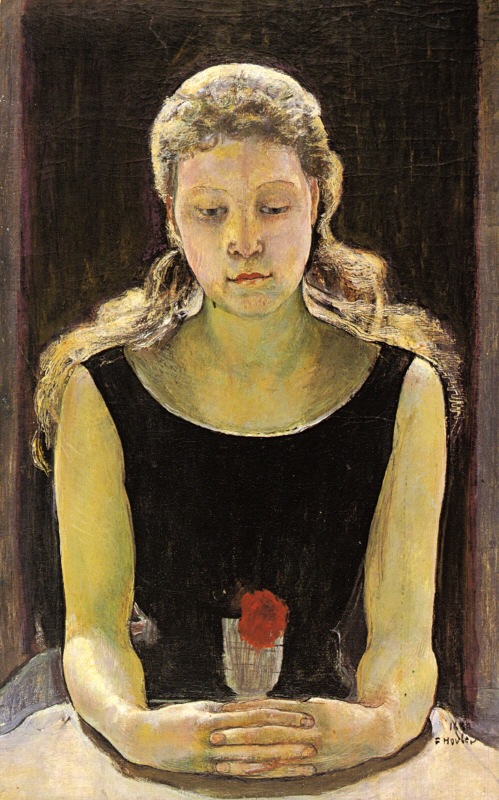
Hyre, detail (visipix.com)
She started a little garden among the rocks that surrounded her house, and she planted a few flower seeds in the stony ground. Miss Rumphius was ‘almost’ perfectly happy. “But there is still one more thing I have to do,” she said. “I have to make the world more beautiful. (an excerpt from Miss Rumphius)
~
What was once a flexible part-time job has in twelve seasons blossomed into a very demanding full-time job for Mary, especially during the late spring and early fall when she is still teaching.
Mary starts her work each year in March and usually wraps things up Columbus Day weekend. In early spring, she begins her rounds at each of the planting sites, checking on the condition of the soil and the planters and determining what needs replacement.
Mary also takes a trip to her wholesalers in New Hampshire, Massachusetts and Vermont to check on quantities and make sure “the colors” are just right (she has some horror stories to tell!)
By Memorial Day or the first week of June (depending on frost predictions and the eagerness of her clients,) Mary is in a planting frenzy, having to put in well over 2,000 plants at fifteen different sites in the period of one week.
After that, she can take a deep exhale, until the end of the month, when she begins to worry that her flowers aren’t growing fast enough. By July though, things are lush and beautiful, and she focuses on watering, watering, watering (and feeding… she feeds her plants every time she waters!)
During the summer months, Mary is up at dawn, making sure she gets to each of her sites by the end of the day, doing half the accounts one day, and the remaining accounts the next.
Before the end of the summer, she’ll talk with each of her customers to see what, if any, changes need to be made for the following season. And in the fall, she’ll be back in the dirt, digging up plants, and getting ready for winter.
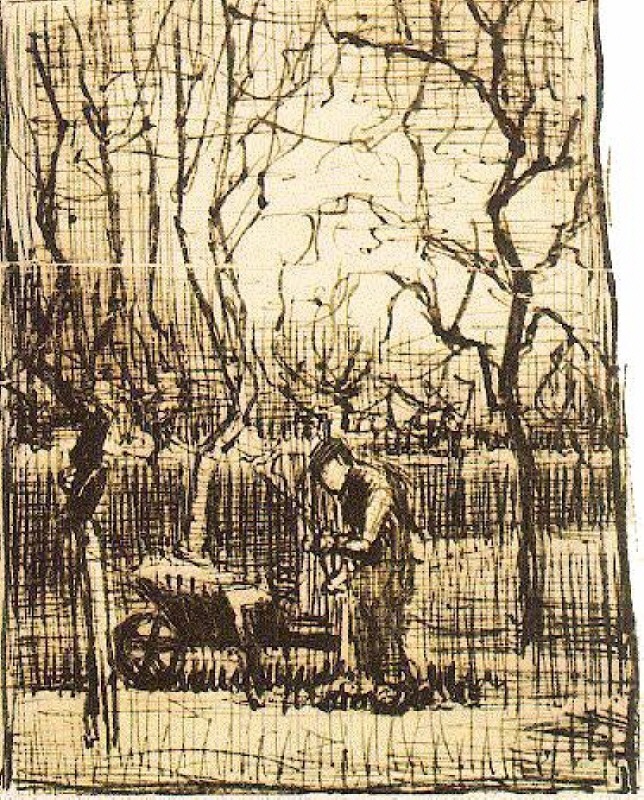
Van Gogh/detail (visipix.com)
The most noteworthy thing about gardeners is that they are always optimistic, always enterprising, and never satisfied. They always look forward to doing something better than they have ever done before. – Vita Sackville-West
“It’s very important to me that the flowers look nice for the community, and I take it very personally if they don’t,” says Mary about her choice of flowers for the town.
“I need something that people are going to be able to see when they’re driving through town at forty-miles an hour. My idea is that less variety of color has more impact. I use the huge geraniums and Grandiflora petunias. While a smaller, perhaps more interesting plant, would be nice, you’re not going to see it unless you’re walking up to it. Driving by, it would just look like a bunch of green. I also need to make sure I use a plant that is hardy and weather resistant, and that can take the dust from the road, from all the cars and tractor trailers. Delicate plants very often aren’t able to survive, they’re choked.”
Something else that Mary had to learn through a lot of trial and error was to cut back the plants. “Sometimes, people will come up to me with a look of horror in their eyes when they see me ripping and tearing out huge arms of petunias,” she recalls.
“I used to think that as long as I had a lot of flowering plants in my barrels at the right time, it was wonderful. And then one day I drove by the Kreemee and saw a whole lot of white and not much red… the petunias had taken over! German ivy will do that too. Now all my plants get haircuts.”
The best fertilizer is the gardener’s shadow.
It’s no doubt that the attention Mary gives to the flowers in town accounts for much of their beauty, and many take notice. “When people think of Wilmington in the summer, they think of the flowers, and I guess I’m a little surprised at how important it is to them,” she shares. “People will often come up to me and say,
‘Are you the Flower Lady?’
‘Are you the one that keeps all these flowers looking so beautiful?’
‘Do you just do this for fun?’
I think they must have this image of me, like I’m Miss Rumphius or something, going around taking care of all the flowers with nothing else to do. I kind of feel bad telling them that I get paid to do this, that it’s a job.”
Mary says that it would be nice to be as carefree as Miss Rumphius. “But the reality is that I have kids to get through ski academies and ready for college.
“I see myself continuing with the job though. I feel like I’m carrying on a tradition, especially now that the girls are helping me a bit. When they were six and seven, it was, ‘Oh, Mom, do we have to?’; now that they’re older it’s different. Each of the girls has their own garden at home, and they love flowers.
On birthdays and holidays we give bouquets, and gifts of flowers and bulbs. The love of gardening has come a full cycle it seems… first my grandmother, and my mother, then my sister and me, and now my kids. Now, I look at this work I do as something to pass on… as a another way of living on.”
The next spring there were lupines everywhere. Fields and hillsides were covered with blue and purple and rose-colored flowers. They bloomed along the highways and down the lanes. Bright patches lay around the schoolhouse and back of the church. Down in the hollows and along the stone walls grew beautiful flowers. Miss Rumphius had done the third most difficult thing of all![She had made the world the world more beautiful.] Miss Rumphius, Barbara Cooney, 1982
All gardens are a form of autobiography. – Robert Dash
“Wilmington has changed so much from when I was a little girl, and often times I’ve thought, ‘Why am I still here? But it’s been a great place for my children to grow up, a safe place,” relates Mary.
“I don’t think Wilmington can ever be seen in their eyes as it was in mine when I was young. But I think this flower thing can carry on. A certain piece of my childhood can be passed onto them… the importance of beauty, and how flowers beautify things.”
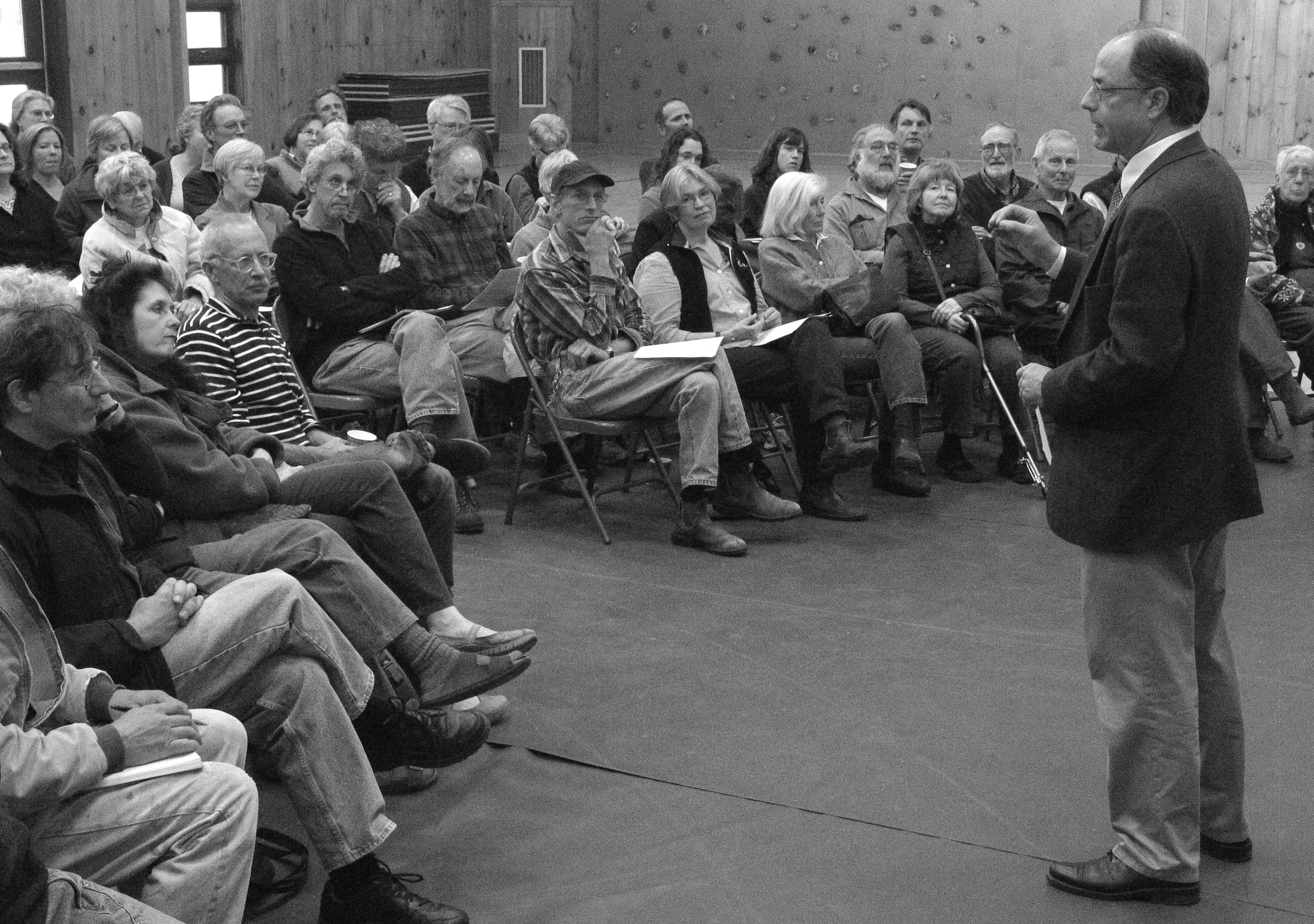
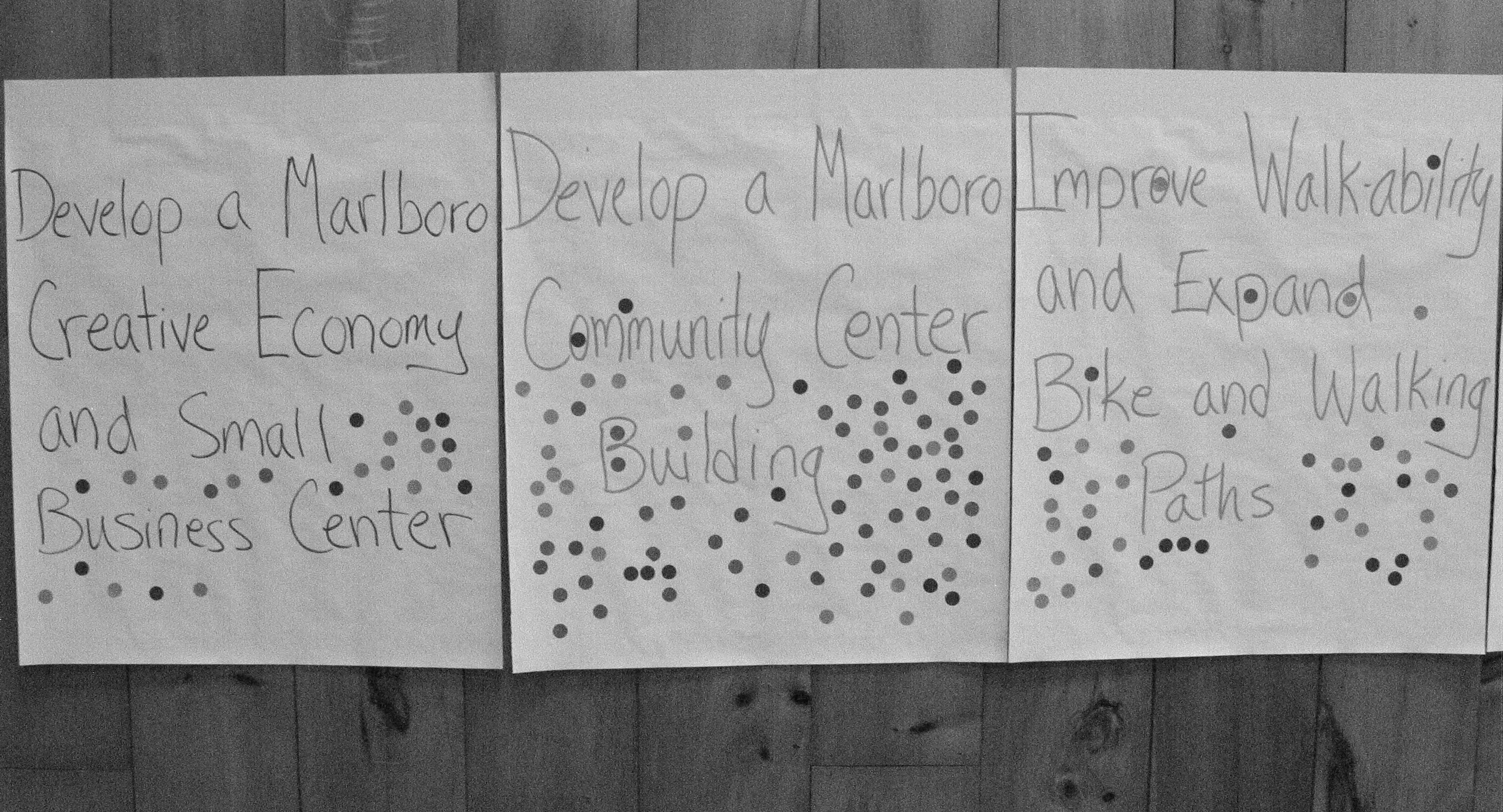
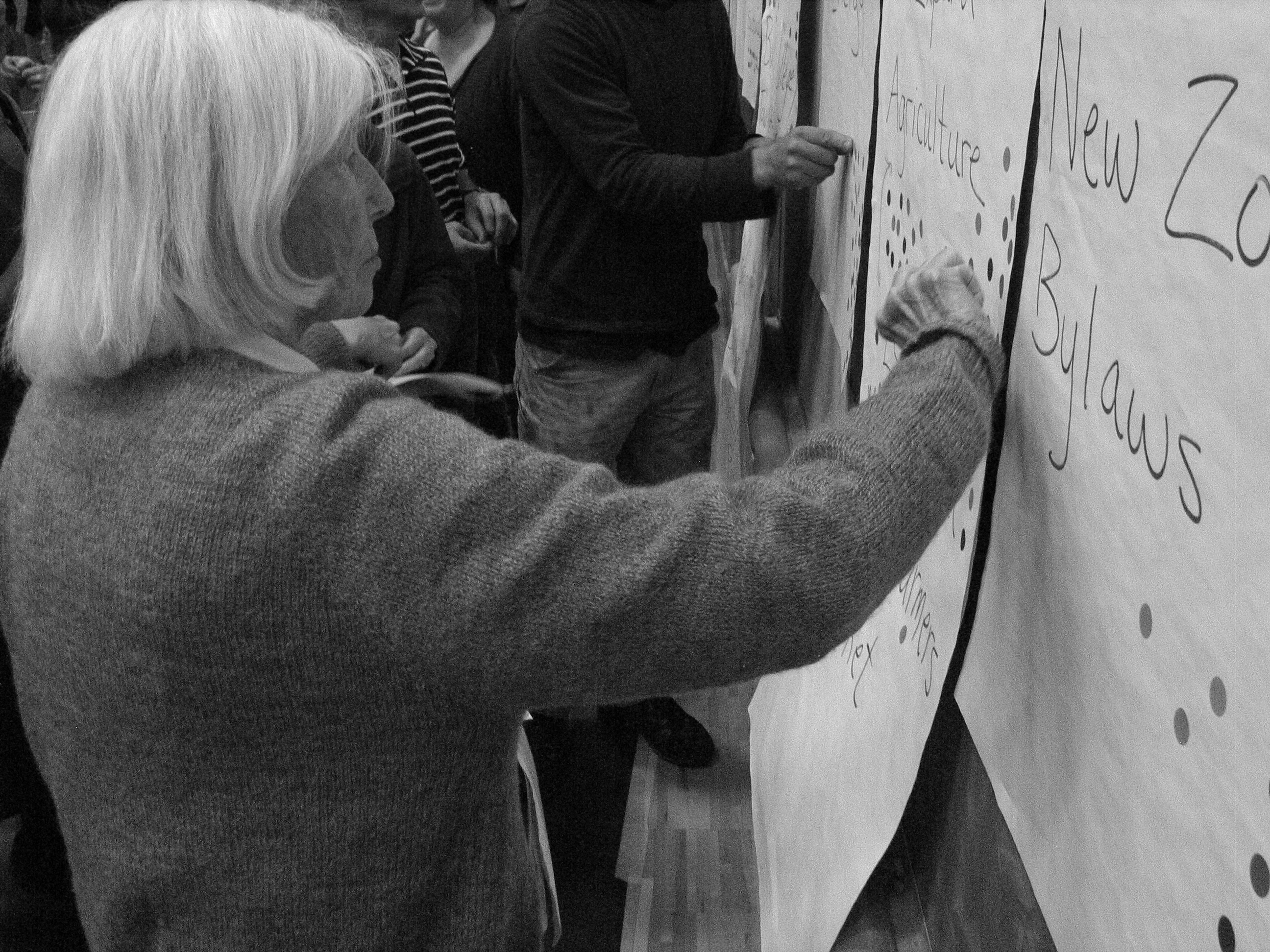
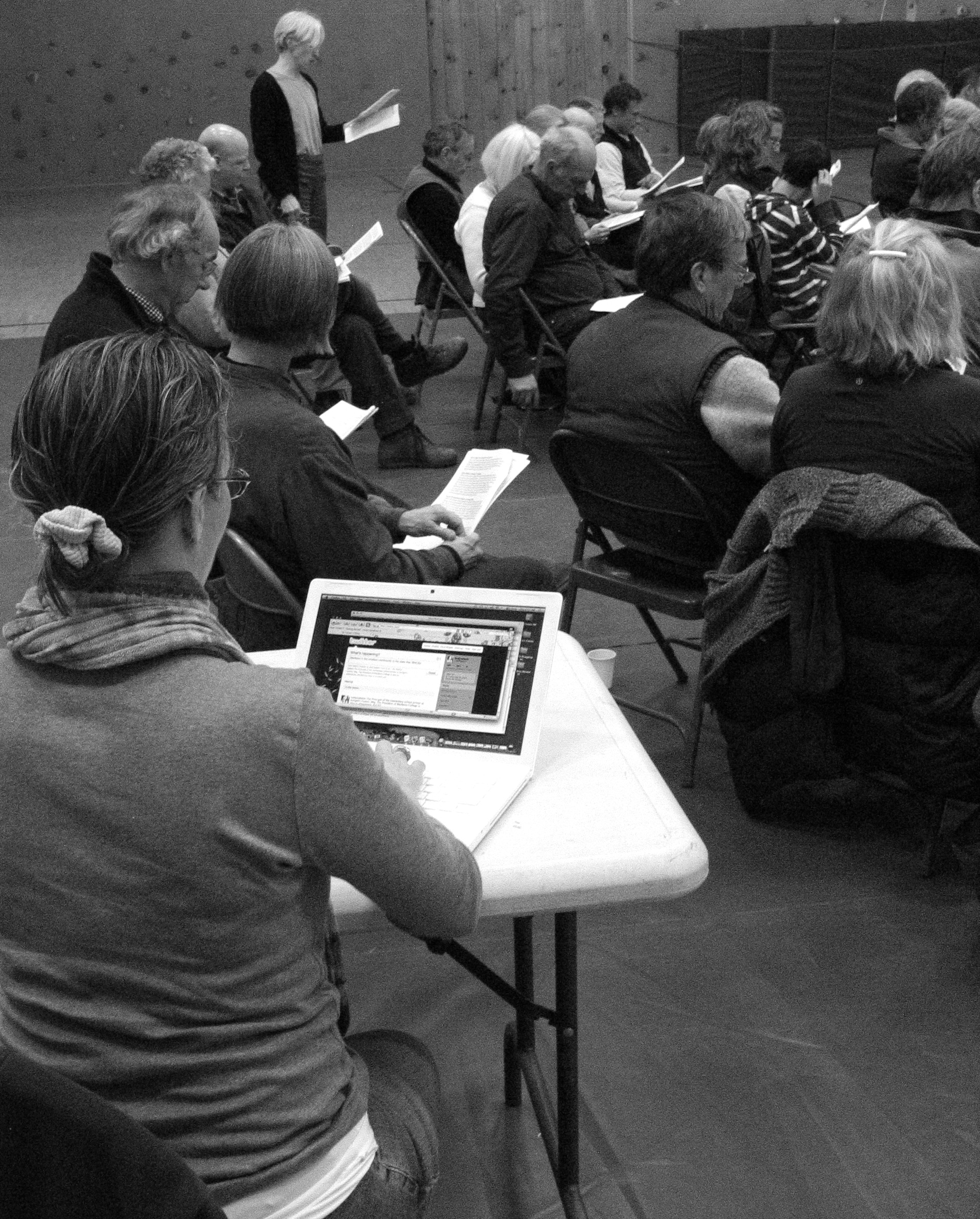
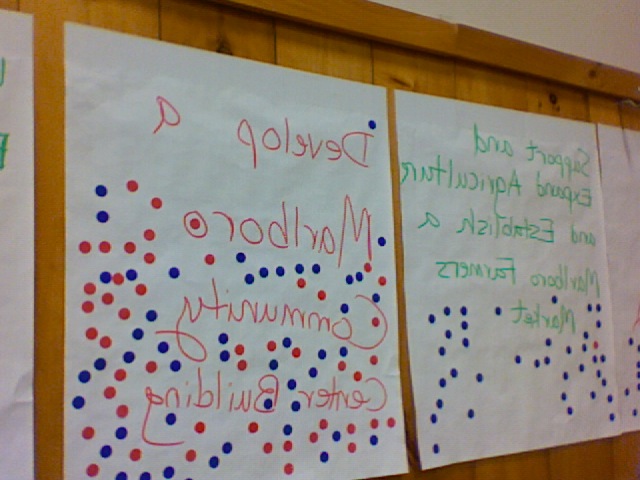
Close to a hundred Marlborians gathered last night for Part II of the Community Meeting Process with Vermont Council on Rural Development (VCRD). Below you can find the Live Twitter coverage of the event (in a 140 characters or less)–including a link to the results of the town vote for the top two community priorities.
Don’t forget to mark your calenders for the last gathering of this three-part series slated for Monday, May 24. VCRD will return with a resource team specifically organized to support the goals set by our town.
“There is no power greater than a community
discovering what it cares about.”
~Meg Wheatley
The Youngest Attendee (photo: David Holzapfel)
Now that we know what matters to us as a community, it’s time to come together to make it happen. Let’s have some fun! (PS. Don’t tell the little one, but a town pub was high on the priority list for most community members.)









 This Vermont Life