Rain Tears

Rain Tears

“Tears are the language of the soul.”

Van Gogh, visipix.com

Yesterday, with the coming rain, I was on edge. I was exhausted and distracted and anxious. When the lightning and thunder began, I lit candles and filled water jugs and waited. During the night, I slept fitfully, hearing the water teeming from the sky; but I am fine.

I live up on a hill in Marlboro, above the Whetstone, a few hundred yards from where it took out the bridge to Camp Neringa and stranded wedding guests for days.

By comparison, my house and driveway are relatively untouched.

And still, I am afraid.

I’ve had enough of flooding and vanishing roads and friends in crisis.

And still, the rains come.

Out of courtesy, I put in a call to my busy, doctor father who tried to reach me during it all. My entire extended family has long been frustrated that I don’t have a cell phone, and when the devastation hit Vermont, they were exceptionally concerned following our days without power or phone.

Today is a holiday, so my father is probably in Annapolis where he spends his weekends sailing. I try him on his cell, and end up leaving a message; after which I feel hot tears spring to my eyes–like those of a child.

Though I’ve never been a “daddy’s girl,” I have to restrain myself from weeping when he returns my call.

Kelly Salasin, Marlboro, Vermont

for more on the floods in VT, click here

Last Sunday

Last Sunday

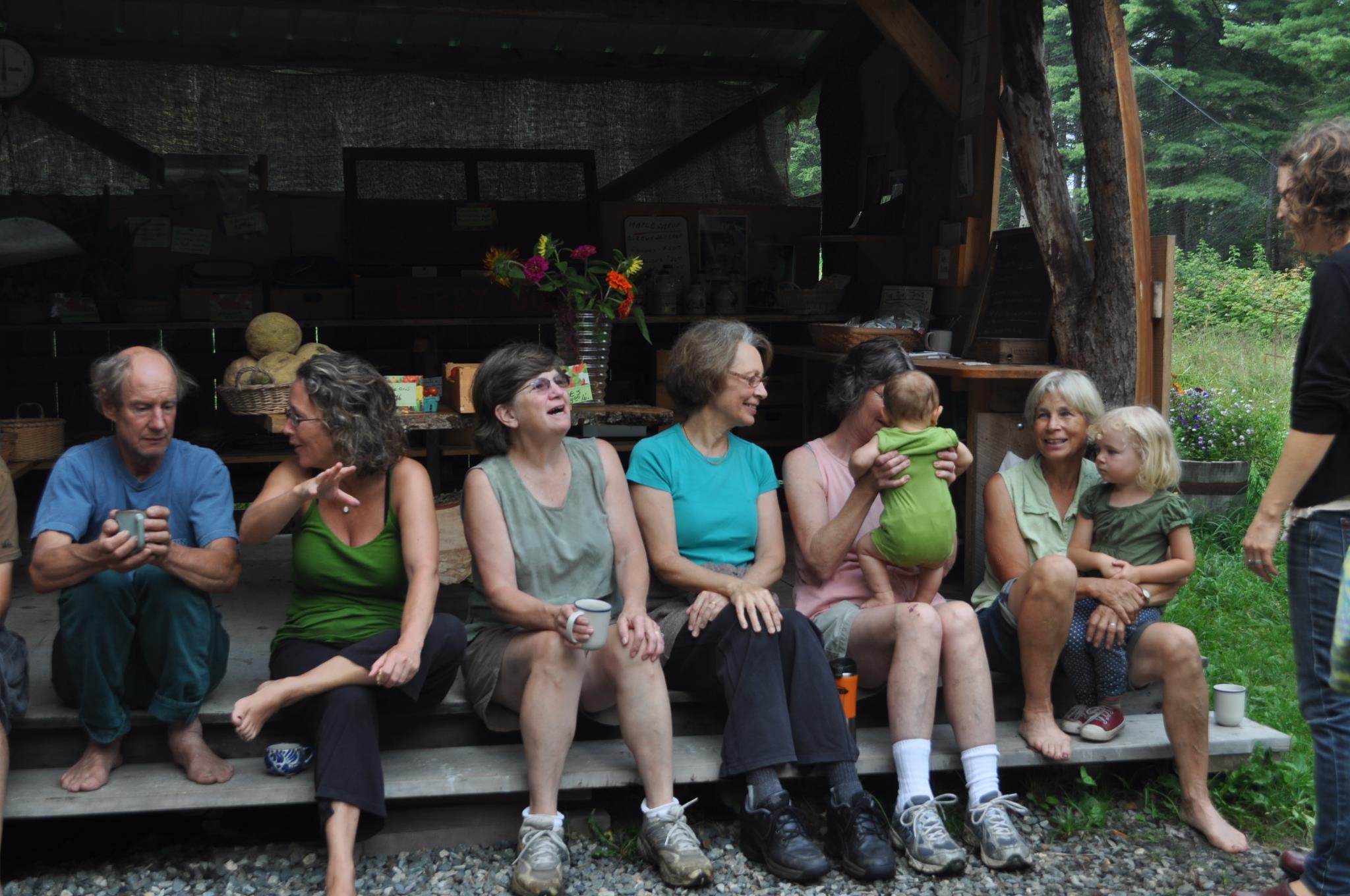
After the flood: Marlboro residents gather at the farm stand on MacArthur Road for the last Sunday of Coffee & Scones; photo: Callie B. Newton, 2011; all rights reserved.

On this one-week anniversary of Irene in Vermont, I’d like to share some of what was posted on Facebook as the day of devastation unfolded:

Very scary in Medburyville. Our bridge to the treehouse is gone and our field and horse pasture is flooding fast. Our horse fence is starting to go down…

Stream in front of my house looks like it may jump the banks… car is packed up and on high ground…. Keep your fingers crossed that my house doesn’t get flooded!

Route 9 near the Brattleboro Naturopathic Clinic is washed out. Be careful folks!

Whetstone Brook raging downtown.

Flat Street flooded.

Lower Bartonsville Covered Bridge gone

The road is gone  just down a bit from our house in Marlboro.

Downtown Wilmington washed away.

As these posts trickled in (and then stopped as people lost power),  it was friends outside of the state, watching the news, who posted about the magnitude of the flooding:

Downtown Brattleboro is underwater with much debris heading down stream. Many many roads and bridges are washed out. Sounds like most people are in isolation where they are. National Guard is in West Bratttleboro  and trying to get emergency help up to Wilmington and Marlboro as they are in total isolation. Rte 9 washed out as well.

In the days following, power was restored to the Green Mountain State, and posts like these next ones expressed what we were all feeling:

I was hoping to wake today and find yesterday a bad dream….

Between the shooting, the earthquake and the flash flood, my little nervous system has been on overdrive.

It’s really amazing how a little brook can change so rapidly into a newsworthy disaster. Very sobering.

The community on Facebook grew day by day, and looking back, I’ll always remember the FB conversation that helped us find our way home on that treacherous night one week ago today. It began with this question that I put out to friends:

We’re on our way up 91 to exit 2, can we get home to Marlboro?

 Ellen:  No

Ellen: Route 9 is closed from Orchard St to Bennington

Ruth: They won’t even let you past the farmer’s mkt. they have engineers coming to check even the little bridges. we’re stuck in west b. if they’ll let you thru to my house, we have room for y’all

Is the back way open to Marlboro?

Jen: Hey Kel, I think you might make it somewhat close to your house if you go through Guilford, but up here the roads are washed out and I don’t think you can get down MacArthur

Jennifer J: Not likely. You can’t get close enough to get to a back roaads

Jennifer J.: IF, and this is a big if, you could go up and over Orchard St & IF the bridge on Meadowbrook was still in tact you could take a right on Western Ave to get to Ames Hill. Lots of questions about the bridges on any back roads.

Ellen: Meadowbrook was closed this afternoon

Jen: Liz made it up here just a while ago on Guilford Center Road. She said you could get down MacArthur from the Ames Hill side. This was a few hours ago, but they did make it…

Someone said that road was flooded

Jen: unsure….. everything is a mess, but it was done a little earlier; i think they only took guilford center to tater lane, the south street to come out by 7-11. then up ames hill…

Alright, we’re going to try that way now. Thanks Jen.

(We never saw the next series of posts until days later when our power was restored.)

Sara: Hi Kelly – Guilford is a mess all the brooks are raging and lots of roads closed.

Jen: Good luck you all!

Stephanie: Be careful!

Michelle: Be Careful!!!!

Sara: If you can get to our house you are welcome to stay here tonight – write if you need directions. At Richmond Auto take Guilford center road go approx 3 miles… I’ll leave the lights on.

Amanda: Are you Safe somewhere??

Stephanie: I just got a message from them. They are almost home, hiking in the last mile.

Michelle: Thanks for the update steph!!!!!

Mary: Just found out about the flooding there. I hope everyone is safe.

Robin: Oh my heavens!

Ciri: Did you make it home?

Robin M.: Did you make it home? Jason saw your car abandoned on Fox. Rd.

Three days later, we were back on Facebook and got our first glimpse of how widespread the damage had been. Image after image revealed the destruction in each of the surrounding towns and beyond. And yet, what resonated most with me and everyone I talked to was this:

COMMUNITY

One reporter who had covered both Katrina and Joplin, Missouri, said that he was struck by how upbeat the people of Vermont were following our catastrophe.

Except for those who lost their homes or businesses, most of us are focused on how fortunate we were. We all know someone who has it worse, and right now (at least in my town) there are more people offering help (even from out of state) than there are requests for help.

Perhaps it’s because anyone who chooses to live here or visit here embraces the natural beauty in a way that transcends comfort or convenience, and relies on community to survive–both physically and personally.

Calvin Coolidge, our nation’s 30th President, summed it up best in a quote that has been circulating on Facebook this week:

“I love Vermont because of her hills and valleys, her scenery and invigorating climate, …but most of all because of her indomitable people. They are a race of pioneers who have almost beggared themselves to serve others. If the spirit of liberty should vanish in other parts of the Union, and support of our institutions should languish, it could all be replenished from the generous store held by the people of this brave little state of Vermont.” ~ President Calvin Coolidge

Kelly Salasin, Marlboro, Vermont

For more on Irene in Vermont, click here.

Things Change.

Things Change.

After the Flood, photo credit: Casey Deane, 2011, Marlboro, Vermont

Things change.

Take my mood for example.

Despite the life-threatening floods, the devastation of my road, the loss of power–and phone–and internet, I’ve been generally upbeat.

Then I got tired. And my mood soured. And I felt desperate–even after my power and my phone and my internet and almost my road were restored.

You know why? Because it was a gorgeously, hot late summer day and I couldn’t go to South Pond.

Isn’t that pathetic?

Here I have friends who have lost their homes or their businesses, and I’m depressed because they’ve closed all the swimming holes in Vermont on Labor Day Weekend.

Then again, if I withheld feeling sorry for myself until everyone else in the world had it better, I’d never get my turn at self-pity.

And what about joy? Should that be limited until everyone has it back too?

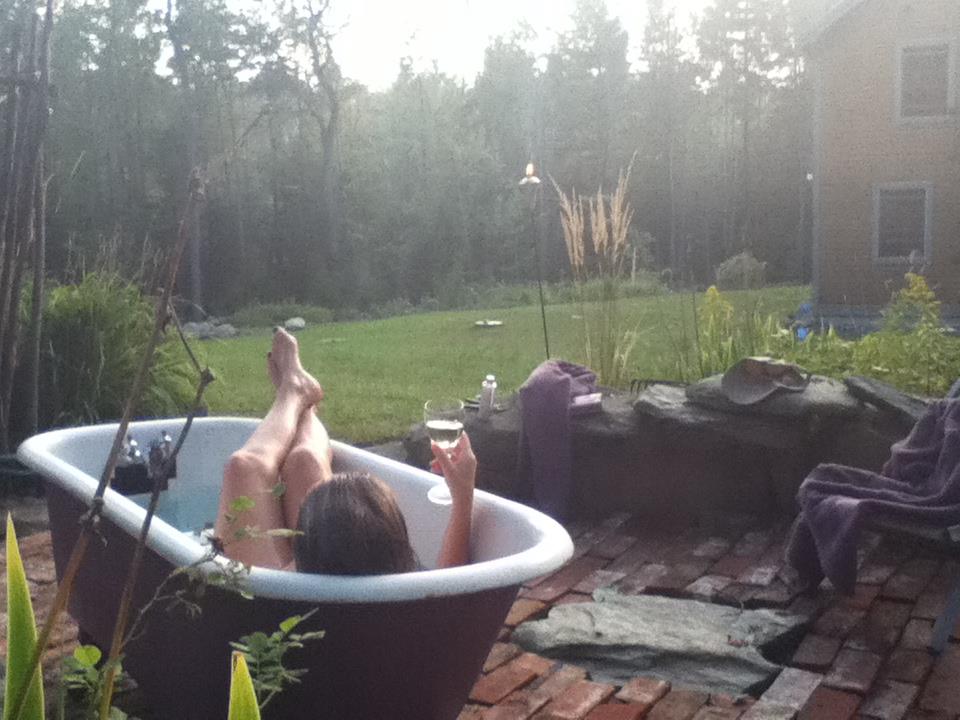
Is it okay to create a pond simulation with an outdoor bath, and glass of white wine, and a view of the setting sun in the West? (What about dancing last night to Simba on the Putney Green?)

Things change.

My mood changed after my bath, and here I am writing again in my own home instead of searching for wi-fi outside of others homes and businesses.

You should have seen the Farmers Market this morning. (Yes, I even went to the market and ate Thai food and got a massage when others were cleaning out flooded buildings and residences.)

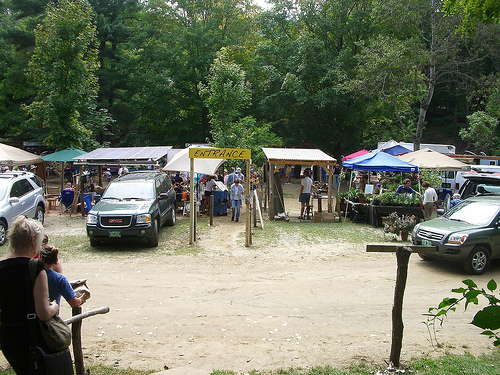
Anyway, the Brattleboro Farmers Market was washed away in the flood on Sunday, but they rebuilt it, as a community, on Thursday. At 8:00 that morning, the parking lot was already filled with volunteers and a grater at work.

A friend of mine told me that just as he put out the last picnic table on the freshly seeded dirt at the end of that day, some travelers arrived in the parking lot, walked down the hill, and set themselves up with a picnic–with no idea of the miraculous efforts that preceded it.

Isn’t that the way?

I’m told that another guy pulled in with his truck asking about the logs lying around, saying,  “Wow, you guys were lucky that you didn’t get any flooding here.”

For your reference, here’s how affected the Farmer’s Market was:

And here’s what it looked like this morning, just 6 days later:

After the flood, Brattleboro Farmers Market restored, photo credit: Amy Boemig, 2011

Things change.

Like the Co-op.

My first few trips there were unnerving, to say the least; but today’s trip had me all but forgetting that there was a murder inside–because I was so engaged in talking to others about their homes and their roads after the flood.

And then there was the afternoon a week ago when a young family nursed their baby in the Cafe and another family enjoyed dinner there–unaware that we were all reeling from loss, and afraid ourselves to step inside.

Things change; and that’s a good thing, even if it sometimes makes us feel forgotten or ignored or irrelevant, like the water that could care less what was supposed to be its bed and what was meant to be our roads.

That first morning after the flood, I wrote about the apocalyptic change the water brought to my dirt road, and to the highway a half-mile away.

Two days later, however, I returned to those forever changed places and found them relatively restored.

This change was almost as mind-blowing as the first.

Everything must change, nothing stays the same, go the lyrics from a song that once made me cry when I first came of age and watched everything I loved disappear.

Now those lyrics comfort me, knowing that not only good things change, but bad things too.

(P.S. What’s changed for the better for you?)

Kelly Salasin, Marlboro, Vermont 2011

For more on Hurricane Irene & Vermont, click here.

Mom, There’s a Fish in the Toilet!

Mom, There’s a Fish in the Toilet!

On the day after Irene assaulted Vermont, the word on the road was that we could be without power for up to a month. When we saw what the flood did to Route 9 (the main highway across our state) we didn’t doubt it.

My husband and I began talking about leaving. “Maybe we should head down to family in New Jersey,” he said.

But of course, we had jobs; and the kids had school–maybe; and we wanted to be in town to help when there was someway to get to the others who had been harder hit than us.

Fortunately or unfortunately, we were stuck like everyone else. No one was heading out of town on these badly damaged back roads, let alone a Honda Civic, when even the National Guard couldn’t even make it down our road with tires bigger than me.

We resigned ourselves to living the way we know how to live without power–candles, and jugs of water, and simple meals; only we couldn’t use the front porch as refrigerator as we did after a winter storm.

Once again we envied those with generators, and talked about getting one ourselves, but I was always wary about the dangers, and it wasn’t the loss of the refrigerator or the lights that hit me the hardest–but the absence of flushing toilets.

I know it’s not very Vermont of me, and I did always want an outhouse with a moon-shaped cut out on the door, but instead I sent my husband down our driveway and across the road to the pond, to fill up a bucket with water, and pour it carefully into the tank of the downstairs toilet so that we might get at least one flush a day.

Thus, the next morning, after my husband left for work, it didn’t take me long to figure out what happened when my young son called up from the bathroom to say,

“Mom, there’s a fish in the toilet!”

But it was the last straw.

“What do you mean?” I called down the stairs, just as desperately.

“A fish, Mom. There’s an actual fish in the toilet,” he replied.

“Is it alive?” I asked.

“Yes,” he answered.

“How big is it?”

And we continued this separate floor conversation like this until I told him, “Just scoop it out, and take it back to the pond.”

“Can’t I just flush it, Mom?” he asked.

“No!” I replied, “It will die. Just scoop  it out and take it back to the pond.”

I know it was a big request for a tiny thing that he’d string on a fishing pole on any other day, but after seeing the devastation to my town, I couldn’t bear another loss, however small.

“I can’t” he replied quietly.

“Why? Just get a cup or something.”

“I can’t… because I’ve already used the bathroom.”

“Pee?” I asked.

“Nope,” he replied.

“Oh.”

And so I resigned myself to sending this poor little unsuspecting fish who survived the Great Flood of 2011 to its end in our septic tank.

“Go ahead and flush,” I called to my son, as one who selfishly demanded water for her toilet.

Kelly Salasin, Marlboro, Vermont, 2011

For other posts from Vermont after the flood, click here.

Or here to read more about flushing toilets after a storm.

If Nothing Else, brush your teeth…

If Nothing Else, brush your teeth…

At midnight, we abandoned the car on Fox Rd. and prepared to hike our way to our house, a mile down MacArthur. As the remnants of Irene blew through the mountains, I tensed with each gust of wind.

“Walk in the middle of the road!” I called out to the boys, for fear they’d be hit by trees or trip into flood-carved caverns on each side of the road.

Each of us carried a pack of essentials–things we didn’t want left in the car, and things we needed once we were home. There were also two flashlights, clever wind up ones, that were also solar powered–purchased conscientiously by my husband with our neglected LL Bean coupons.

They sucked.

The light flickered on and off, obscuring the view of the road when we most needed it to avoid falling into pits or tripping over debris. We begged each other to take turns winding to give our aching arms a break, as there had been no sun in our glove compartment to charge them.

I silently cursed my husband for not being a boyscout, and equally questioned how I had gender assigned responsibility for our safety.

As we carefully made our footing down MacArthur, we looked for any signs of power in the handful of homes that scattered this steep rural road, but not a flicker of light was seen.

Had we been home before the storm, we would have taken the necessary precautions–namely filling the tub with water to flush the toilets, and filling other jugs for washing dishes and drinking. My husband did fill our large water cooler and left it in the basement before we left for the beach; but hurricanes rarely affected us here in this landlocked state, and this was just a precaution.

It seemed crazy to leave the protection of the mountains with a hurricane coming up the coast, but we had already arranged the house trade, and preparations for the wedding that our house guests were attending were already in full swing across the pond at Neringa Camp.

It was the mother of the bride who had arranged the exchange, and we rode out the hurricane at her house in Cohasett, Massachusetts. I sat on the screened in porch while the wind whipped through the town, and jotted down this little ditty after sketching the trunk of the hundred year old beech on her front lawn.

Blizzards belong in the mountains
Hurricanes at the sea
I’m happy to sit by the ocean
While the wind blows on me

The next morning we woke without power, and yet there was little word of anything serious in Vermont so we began packing to leave. I would have preferred to wait until morning, but my husband had a school inservice the next day, and the winds had died down enough that it was now safe to travel.

Our three hour drive to Vermont was non-eventful and just as we got into the state, my husband stopped to use the restroom at the Welcome Center on 91. I was annoyed at this delay, just 30 minutes from our house, but he said he couldn’t wait, and so I passed the time using the internet.

It was then that I began to read first-hand accounts of the storms effects in Southern Vermont. One by one, Facebook posts told of the flooding in Brattleboro and of the closing of Route 9.

I put a post up myself to see if how the back roads were, and was alarmed to hear that many bridges had flooded. To play it safe, we called a few area hotels so that we could finish our trip home in the light of day, but everything was full or flooded.

My sister in Brattleboro offered her floor, but we weren’t sure we could even get there, and we had a car full of boys–my own two, and a teenage friend. If things were really this bad, we’d rather be home in Marlboro than stranded in town.

A state policemen pulled up beside us in the parking lot of the Welcome Center, and we asked what he knew, but he knew less that what we discovered through friends on Facebook.

We considered heading to a shelter.

Instead, we made the decision to head home.

We pieced together a backroads route from FB posts, and made our way toward Marlboro via Guilford, bypassing much of Brattleboro. So far so good.  The roads were wet, but paved and sturdy.

When we finally made it passed Lilac Ridge Farm to Ames Hill–a dirt road that runs parallel to the highway that had been closed–we came across a huddle of emergency vehicles and men on ATV’s.

A rescue mission was in progress for folks stuck on Stark Road–just across from our own. They wouldn’t let us proceed because they didn’t want us getting in the way with their operation.

We waited.

We reconsidered trying to make it to my sister’s, or to a shelter–if there was any–and once again, we decided on home.

About an hour passed before the men returned, and they told us that Ames Hill was passale–with four-wheel drive and high clearance. “It’s touch and go,” they warned.

Without giving it another thought, or asking my opinion, my husband jumped back behind the wheel of our Honda Civic; and soon, there was no turning back, for that would have been more treacherous than continuing.

At Robb Hill Farm, a car like ours sat sideways teetering on the brink of a cavernous hole where once the road had been. The car was empty, and we continued, stopping when needed for the boys to remove large rocks and to the lighten our load so that we could make it over ditches.

Each time they stepped into the dark, my stomach clenched for fear that they would fall into what should have belonged in a nightmare–roads eaten away by water, leaving only a narrow, rugged path for our car.

There were many such moments like this, but we were never in real danger, though more than once I worried that we could become one of those tragic stories dismissed by others for being stupid.

Why did that family try to get home, they’d say.

We didn’t know what we would find once we got there either. Would there still be a driveway? Would our house be flooded? Would the guests still be there, with no where to go?

On Facebook, I had read that Neringa pond had been flooded, and that the wedding guests were now stranded because the bridge had washed out, but we could see little of this in the dark, and we were eager to get to our own home.

There were no lights to welcome us, but we could make out no damage either, not even on our steep driveway. The neighbor’s jeep was there, and our friend’s truck, but inside the house was empty, and we lit candles and brought out the reserved water, and headed up for bed.

It had taken us over three hours to get home from Brattleboro which is typically a 15 to 20 minute drive, and I was weary from worry.  In fact, I worried all weekend when my hometown at the Jersey Shore evacuated. I never expected that we, in Vermont, would be harder hit than they.

I brushed my teeth with the water from the car, and then asked the boys to do the same. When my teenage son said that he had left his toothbrush in the car, I was livid.

“Why wasn’t it in your bag?” I said. “Did you just throw it in the trunk?”

Fuming, I rustled through the drawers to find an extra tooth-brush by candlelight.

“Mom, just forget about it,” my son said, irritated by my urgency.

“I’m not going to forget about,” I hissed. “Brush your teeth with your finger!”

My son’s fury equaled mine then and he screamed, “Why do you have to freak out about teeth brushing at a time like this?”

I took a deep breath and wondered the same thing.

“Come back here,” I said, as my son stormed off to his room. “This isn’t about teeth brushing. This is about the culmination of that crazy trek that we took to get here.”

“I know,” he softened, and so did I, and we hugged each other good night, with clean teeth.

Kelly Salasin, 2011

For more about Irene in Vermont, click here.