Hawk cries atop the dead Birch in the South.
Thunder percussion.
Camp Neringa treble.
(MacArthur Rd, Marlboro, 2012)

Hawk cries atop the dead Birch in the South.
Thunder percussion.
Camp Neringa treble.
(MacArthur Rd, Marlboro, 2012)
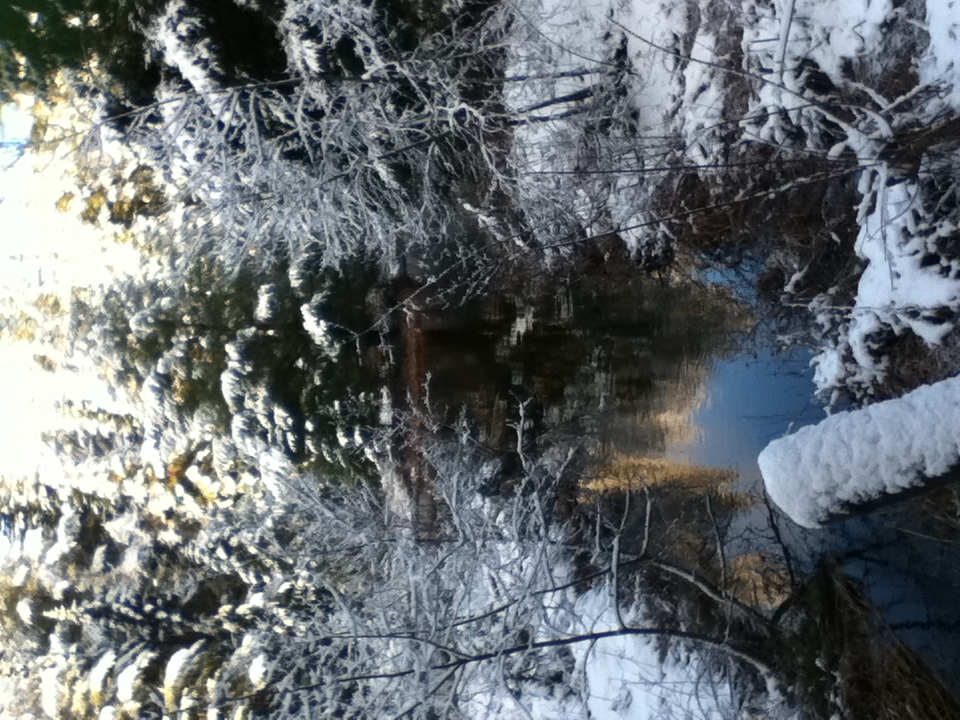
i wake to/
sugar on spring/
and watch/
as an owl/
sweeps across/
the field/
of my meditation/
in the falling snow
kelly salasin, april 2012
mud makes for quiet roads
dirty floors
and
grownups engaged in child’s play
Kelly Salasin, last day of winter, 2012

Tonight’s Snow Moon is so spectacular that even after an egregiously long day at work, I must share an excerpt from the equally spectacular 2012 Earth Story Calendar by local creative, Peter Adair.
The February page of his calendar opens with these show stopping words:
Earth Adopts a Child: The Moon Appears
I’ve never met Peter, but I’m studying to be a yoga teacher with a friend of his, who gifted us this calendar.
I’m a gift lover so this was a nice surprise, but it wasn’t until February that the magic of it began to unfold.
While the art of January’s Supernova Event was stunning, it’s February’s Moon that drew me in. Like a ballad, the accompanying text sweeps me up into its story again and again.
According to Peter, it’s inspired by the work of a mathematical cosmologist (Geez, where do they go to school?) who is described as having a heart of a poet.
No kidding:
Soon after Earth’s formation, during a time when asteroids rain upon the fledgling solar system, a sizeable intruder strikes our globe in a sideswipe collision. From this shuddering meeting, a portion of Earth’s body spews into space. The interloper, its momentum reduced through the encounter, succumbs to Earth’s gravitational embrace and is received into orbit. There, it coalesces with the scattered material of Earth and becomes our Moon.
My gosh! Is it me or does that take your breath away?
But don’t stop there, it continues…
Earth’s daughter gradually slows our planet’s spin to its accustomed twenty-four hour rotation, establishes the axial tilt making possible the four seasons, and produces the caressing tides along shorelines that will become the fecund wombs of evolving life.
Who needs March when February makes you swoon;
and No, I haven’t looked ahead.
That’s taboo!
But how fortunate are we to live in such a place–
with such a daughter shining above us.
It wasn’t until I moved to Vermont that I began to truly notice the moon. Others taught me how. Women mostly. And now Peter, and his “ode to creation” in the Earth Story Calendar. I kind of feel bad for telling you about it because it looks like they’re sold out.
There’s always next year, and in the meantime, take a drink of that gorgeous daughter in the sky.
Kelly Salasin, Snow Moon, 2012
More from the Earth Story Calendar:
The scientific account of Earth’s formation and development is a story of vibrant creativity and stunning transformation. The journey begins within the fiery core of a star, and concludes (for now) with the emergence of a species able to comprehend its origin. We have learned that the unfolding of the human is interwoven with the unfolding of the planet. This is the theme of Earth Story calendar.
We brought home the tree this past weekend–from the wind swept farm upon McKinley Hill in Jacksonville. I don’t know if it’s really called McKinley Hill, but those are the people for whom we remove our mittens to scribble stiffly: “twenty dollars and oo cents” in frozen ink each year.
We thought about waiting for more snow to lend more of the holiday feeling, but we opted for what we had, not knowing if the weather would offer more or take what little remains.
The sun was bright on the hill and the view spectacular, and so was the wind which made for little argument over which tree was best. (Even the new guy at the baler was surprised at how quickly we returned dragging a balsam behind us.)
It was such a tiny tree that it hardly needed shortening once home, but my husband took off a foot any way–with the chain saw–which my 16 year-old defended, “He’s a man. He has to use the most powerful tool available.”
At the farm, a simple hand-saw had been employed by our resident enthusiast: Eleven-year old Aidan who also pulled the tree carriage down the hill and just as enthusiastically dragged it back up while my husband loaded the evergreen onto our Civic.
I love seeing trees atop of cars. I like counting how many pass us in a day. This is not p.c. of me, I know; many of my rural friends feel compromised cutting down a Charlie Brown rut from their own woods, while others forgo the tradition altogether and hang ornaments from evergreen boughs.
This year I actually considered this, not with environmental consciousness, but with fatigue. I didn’t want to face the dramatic overhaul that is required in tiny living room to accommodate a tree; but this year’s choice was so trim–we only moved a single chair.
Our tradition is to leave the tree unadorned as long as possible to appreciate it for its simple gift of green. Next we add the lights, and these too are left twinkling in solitude to inspire us on dark nights.
The last step is to add the ornaments, unwrapped from their boxes, labeled with dates and gift bearers, and carefully placed upon the boughs for the right effect of color, shape, medium and reflection.
We add egg nog and festive finger foods to this occasion, and then do the same with the holiday leftovers when it comes time to pack up the ornaments after the holiday.
The tree itself remains, lit and then unlit, until I can finally bear parting with the Balsam beauty in favor of order and an extra chair.
The Christmas tree is one of my favorite traditions along with the advent calendar and a daily reading from National Wildlife’s, December Treasury. A tribute to the Evergreen is today’s offering:
The Ancients
One need not go into history to find the reasons for veneration of the evergreen tree or bough as part of the Christmas season. They are of the enduring things of this earth, and man has known them as long as man has been here. The pine, the spruce, the hemlock, the fir – all those conifers that know no leafless season – have been held in special favor when man would have symbols of life that outlast all winters. And even more enduring, in geologic time, are the ground pine, the ground cedar, and the club mosses, most venerable of all the evergreens.
We gather them now, even as the ancients gathered them reaching for the reassurance of enduring green life at the time of the winter solstice. For the pines and their whole family were old when the first man saw them. Millions of years old, even, even at a time when millions of years had no meaning. When we gather them we are reaching back, back into the deep recesses of time. But, even as the ancients, we are reaching for reassurance, for the beauty of the living green but also for that green itself, the green of life that outlasts the gray winds, the white frosts, and the glittering snow of winter.
So we bring in the pine, the spruce, the hemlock – and now, because of the cultivation of Christmas trees on a wide scale, we do so without desecrating the natural forest. We bring the festoons of ground pine and partridgeberry, feeling a kinship with enduring things. They help us to catch, if only briefly, that needed sense of hope and understandable eternity.
-Hal Borland
 This Vermont Life