A rainy Wednesday in March brings to mind the memory of orange, chocolate-chip scones.
This would be just the day to sit a spell at the counter at Sweeties on Route 9 in Marlboro–sipping a latte, taking in the aroma of bacon, the morning conversations, the ebb and flow of townspeople and tourists beginning their day
Sweeties has been closed now for a handful of years and we’ve all grown accustomed to having to leave town for gas or a six-pack, but the absence lingers like a loved one, and sometimes rises like an ache, particularly in wintry months or on rainy days like today.
“After the General Store, comes the Post Office,” says a neighbor. “Then the school.”
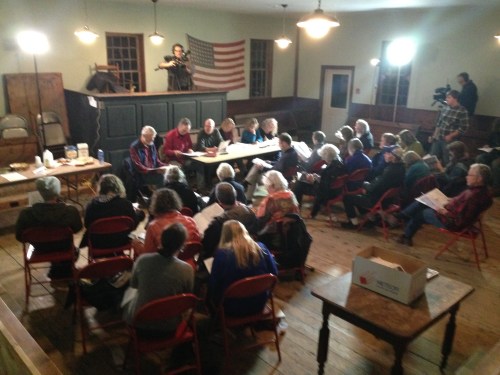
Marlboro School was at the center of last week’s Pre-Town Meeting in response to Act 46 which seeks to consolidate school governance.
“Forced, short-sighted, rushed through legislation,” is how one woman described it.
Marlboro Pre-Town Meeting, Kelly Salasin, 2017
A discussion of the unintended consequences of Act 46 ensues; and I’m surprised by a consideration that hadn’t occurred to me until then, and how deeply it shakes me–not the loss of our precious Junior High, or the loss of our vibrant voice; or how these losses will reshape our school, and our town; but something that strikes at the center of self-governance:
Town Meeting.
I know not everyone can make it on the first Tuesday in March, and I know that efforts in other towns to shift the meeting to an evening or a weekend haven’t produced the desired results; But our old Town House fills up with body heat and breath and voice and community, and that’s something.
And even in the years when you’re not in a chair or on a bench or at that front table or up at the podium, the gathering holds space for who we are and how we live and what happens here, not just in Marlboro, but all over the Green Mountain state, and even across our nation, as Bernie proved to be true.
Sure Town Meeting would continue for awhile; the old timers here are hearty like that; but the absence of the school budget–ie. the absence of children at the heart of decision making–would hollow out the gathering, until it became a dusty relic of itself.
“New Stairs,” Marlboro Town Hall, Kelly Salasin, 2017
Just before our Pre-Town Meeting closes, a follow up question about our “Geographically Isolated” and “Structurally Isolated” school comes from the floor:
“If we find that it doesn’t work for our town, can we go back to what we had?”
The response sends a chill through my body, particularly this year:
“Once you take it apart, you can’t build it again.”
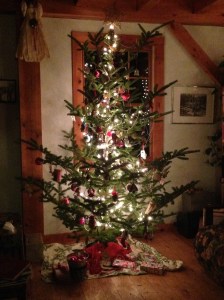
We tucked our celebration away at the end of December, but the holiday season has dragged into the New Year for our family–by the Merry Mulch Fundraiser.
On any given day, we receive 7 to 21 calls about Christmas trees. (Of note: Despite a progressive populace, not a one referred to theirs as a Holiday Tree.)
Our son volunteered to receive these calls to offset the cost of his highschool band trip. His mother, who did not play a band instrument, is a writer. Self-employed. In the home. Which is why it was both necessary and excruciating to succumb to this daily intrusion. (I stopped answering the phone in 1989.)
On any given evening, my son spends 20 to 60 minutes replaying (and replaying and replaying) messages; compiling information; and making follow up calls.
More than the volume of Merry Mulch activity, we are surprised by the volume of good will. This is its 27th year of the Music Department fundraiser at Brattleboro Union High School. Some of the callers let us know that they have been participating since its inception. One woman informed my son that she was the one to conceive of it.
Our hearts are equally touched or tickled or annoyed by the characters we find on our answering machine. The warm and gravelly sound of an older man. The busy staccato of the cell phone caller. The confused caller. The comedic one. The irritated. The kind. The repetitive. The overly informative. Their quirky names. Corky. Junio. A woman named Mann. (My son wishes he could meet them all!)
When Aidan showed up at school that first week with close to 100 orders, the band director offered to place our phone number last on the radio and newspaper call list instead of first.
I am almost certain that we will never (or always) do this again.
~
Note: if you live in Brattleboro, here is the link to more information. There is one more pick up Saturday remaining. Calls must be placed by Thursday. Please don’t call the first number. http://buhs.wsesu.org/merry-mulch
I think my parents suggested fiddle because there was this insane teacher named David Tasgal. He was kind of nuts, but he had an amazing ability to communicate music to little kids…. He was definitely an inspiring figure for me, not only musically, but also because he had this slightly cracked sense of humor.
He had this deadpan vibe that I thought was hilarious. ~Sam Amidon
play |plā| verb
engage in activity for enjoyment and recreation rather than a serious or practical purpose
• amuse oneself by engaging in imaginative pretense
• (play with) fiddle or tamper with: has somebody been playing with the thermostat?
I never thought about David’s age before, but if I had to guess, I’d say early sixties, which is why I dismissed the news that a 72-year-old man was struck on his bike on Bernardston Road in Greenfield, Monday afternoon.
David has been a part of the Marlboro Elementary School family in Southern Vermont for over a decade. His quirky, fun-loving approach makes this classical instrument accessible to all kinds of kids; and his death this week leaves our school family aching–especially as I imagine all those young children–with their tiny violins–waiting for him on Tuesday morning, ready to play (and I mean play.)
A list of David’s original compositions for the violin lends insight into his heart for children, while revealing his characteristic playfulness:
David’s collection of music instruction books.
Blast Off,
Marching to the Practice Room, The Tough Cat,
Goldfish Variations, Cha Cha Cha Cha, The Rabbi Dances with his Dog
and Bingo Suddenly Meets Mozart
My youngest son, Aidan, who studied with David from 1st through 8th grade, believes that one tune in particular had a handful of title changes over the years: Song for a Pet Who Died became Song for a Pet Who Ran Away became Sad Clown Fish became The Lonely Fiddle–all in attempt to make the children less sad.
Aidan also marveled that David could compose a tune such as The Duck Song–from a single note–and still make it “interesting and satisfying.” As a parent and a teacher, it was particularly pleasurable to see so many children, of all ages and skill levels, play together, and David’s unique approach made that possible.
David swept in for school events wild hair and wild shirts, and then began without fanfare, keeping the focus on the violinists, while enthusiastically accompanying them on piano. In fact, it’s at the piano that I remember David best. I loved the mornings when he’d arrive a bit early for lessons–at the tail end of All School Sing–and then slide his way onto the piano to add pizzaz to our last song.
On the evening after David died, I entered the school auditorium to teach yoga, but felt his presence so strongly that I could barely begin my class. To soothe myself before I left, I placed a small light on the piano to sit shiva with David’s spirit through the night.
We lit a candle at home that night too. Our older son, Lloyd, 20, who was in David’s very first class at Marlboro recalls how perfectly David tailored lessons to engage him and his more sports-oriented peers: “At one point, he gave us percentages so that we’d compete with each other,” Lloyd recalled.
Aidan was uncharacteristically quiet as his brother reminisced. Aidan graduated from Marlboro in June, and on that night he tucked a small gift aside–a bar of soap–his favorite because of its crazy colors and textures and how he gets to slice it to size–and especially because of its name: Dragon’s Blood. He thought David would like it too.
Aidan gave himself whole-heartedly to music during his years at Marlboro and has continued on at the highschool just as enthusiastically; while Lloyd just about gave up on the violin in Junior High. At the time, I drafted a parenting piece entitled: The Violin Wars, which alas, I never finished, until now…
Our boys practicing together, many, many moons ago.
The Violin Wars
My 13 year old sits slumped behind me in an arm chair in my office while I blare Dave Matthews, Ants Marching and then Last of the Mohicans–two “cool” songs with engaging strings that I hope will entice him to play along and reignite his lost passion.
The violin sits on his lap.
Things between them almost ended–abruptly–two weeks ago, though truthfully, they’ve been on the rocks since Lloyd was about 10–the time of the First Violin War–an apocalyptic parenting moment–complete with yelling and threats and stalemates–followed by the stark realization that I had crossed the beginning of the end of my role as commander and chief.
Lloyd with his first set of strings
But a deeper truth is that Lloyd and the violin have been together forever, into their ninth year, and they courted even before that. As a toddler, Lloyd offered rapt attention to any string music he came across–live or recorded–contemporary or classical; and as a preschooler, he brought the same toy guitar to show and tell every Friday, while truly longing for a violin.
When we finally found a toy one to match the guitar, he was at first delighted, and then quickly disappointed with its inferior sound. He insisted he needed a “real one,” but as neither my husband or I were musicians, we didn’t know how to go about that for such a small child.
One afternoon, while walking down Elliot Street in Brattleboro, however, Lloyd pointed to a sign above the sidewalk–with a picture of a violin–and said: “Let’s go up there.”
We climbed a set of steep stairs, and entered a small shop where violins–of all sizes–hung from the ceiling. I felt like a fish out of water, but Lloyd looked up in wonder. Reverent. Riveted.
The shopkeeper came around the counter, took out a tape measure from his apron, and sized Lloyd up.
Lloyd with his first “real” violin.
“Come back in a year,” he said.
Lloyd was devastated.
But when he entered kindergarten that fall, something magical happened: the school instituted a pilot program with the Brattleboro Music Center and Lloyd came home carrying a case with the real thing inside.
Despite his passion, Lloyd was not a virtuoso, but he stuck with it, year after year, and so did the school–deciding to continue the program until the fourth grade when children could begin traditional band instruments.
Many of Lloyd’s peers gave up the violin in favor of a flute or a trumpet or a drum, but not Lloyd; he kept playing until he was the only one holding a violin, which is where we find him now, at the beginning of 8th grade:
“I want to quit,” he says. “I can’t take it anymore.”
But he isn’t resolute. He is miserable. Torn. Angry and frustrated. Feeling betrayed, by himself.
I’m not sure how to help.
Our tempers mount.
With so much at stake, I feel the SecondViolin War coming on, but now I am a wiser or at least less foolish parent, so I suggest we reach out for support. I quickly compose an email to dispatch to family members–cousins and grandparents, great aunts and uncles, and regular ones too.
The replies flood in.
Do what you want, says one. You can always pick it up again.
Stick with it, says another. You’ll never pick it up again.
With each response, Lloyd feels tossed about–first one way; then the other. In the end he does. Stick with it. But half-heartedly. And once in high school, he leaves it behind, while watching his little brother, 5 years his junior, follow in his footsteps, sticking with violin, through the 8th grade, but so whole-heartedly that it inspires Lloyd to pick it up now and again… “just to see how it sounds” (and to see if he can still play better than his younger brother.)
Lloyd is grown now, a man of 20, and to our surprise, he recently called to say: “I think I want to start playing again.”
We don’t know what will come of this spark, but it warms us, particularly in its timing.
We attended David’s funeral together. No one even balked at the suggestion. Not Lloyd who was leaving that afternoon on the train for Burlington. Not my husband who had to arrange coverage for his classes. Not Aidan who was… well… 15.
The music was exquisite. The service solemn and playful and irreverent. At one point, a handful of children came forward to play some of David’s pieces for beginners. I nudged a reluctant Aidan to join them. He sat firm in his seat until he saw another same-age peer, across the room, move toward the altar.
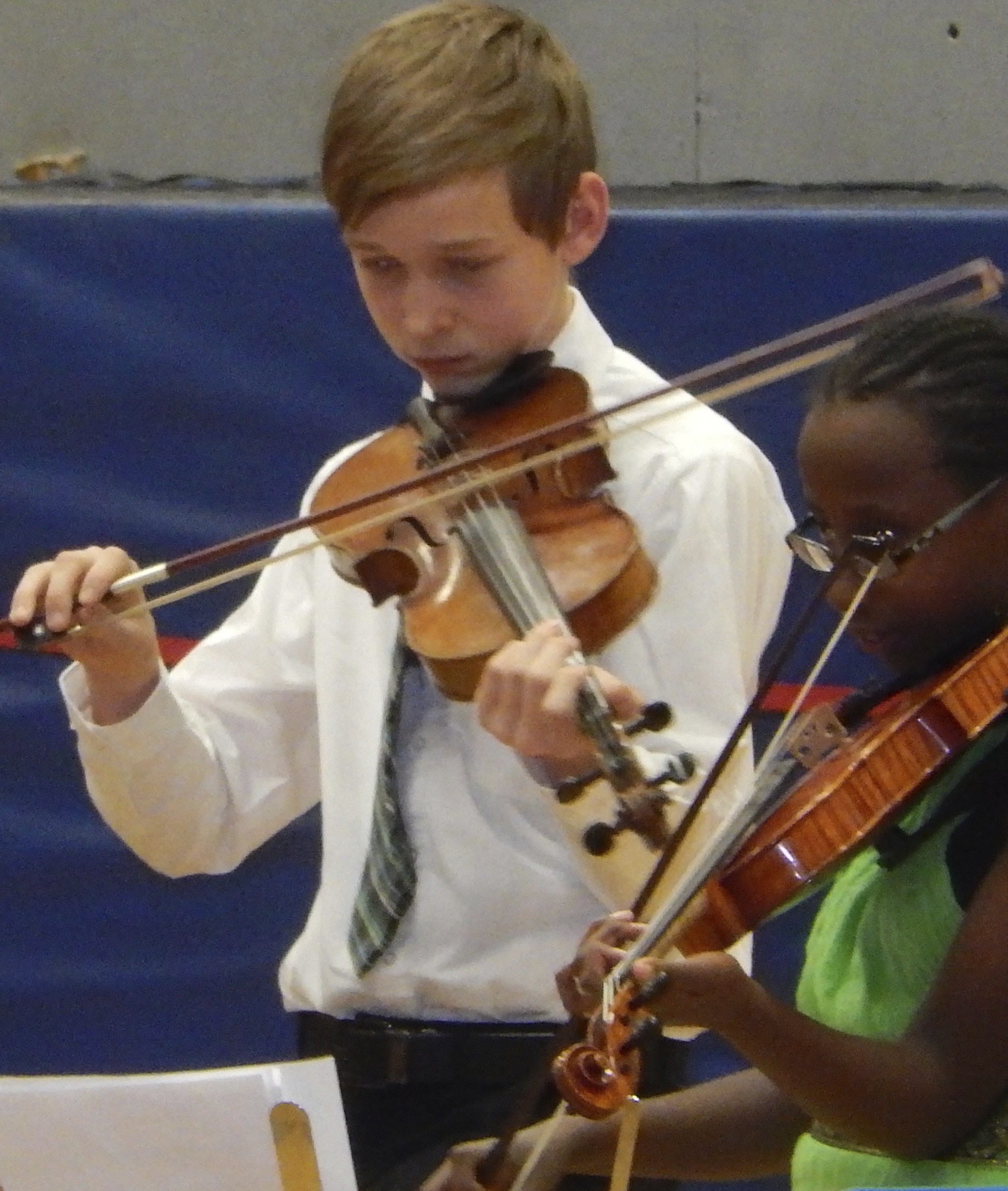
Aidan playing beside a younger peer at the last concert with David at MES.
Aidan swiftly brought the violin case, hidden between his knees, to his lap, and as he did, I felt the collective attention of all those who shared the private mourning space around us.
We watched transfixed as he opened each latch, and carefully lifted the instrument from its bed, and then there was a palpable embrace as he approached the altar on our behalf.
When the children began the last of three pieces, we were invited to hum along, after which we accidentally broke into the applause we had held inside for the soloists who had so stirred us earlier.
As Aidan rejoined us at the end of the pew, I turned toward him to mouth the words: “Thank you,” just as he locked eyes with mine, nodding his head, offering the same, not once or twice, but a handful of times: “Thank you. Thank you. Thank you…”
The sky was a stunning blue as we exited the temple doors that afternoon; the surrounding streets lined with the cars of those who came to grieve David’s departure–students, colleagues, family, friends.
As we walked, Lloyd spoke to me of the music–of the viola solos–played by loved ones.
“I could barely breathe,” he said. “I couldn’t remember how.”
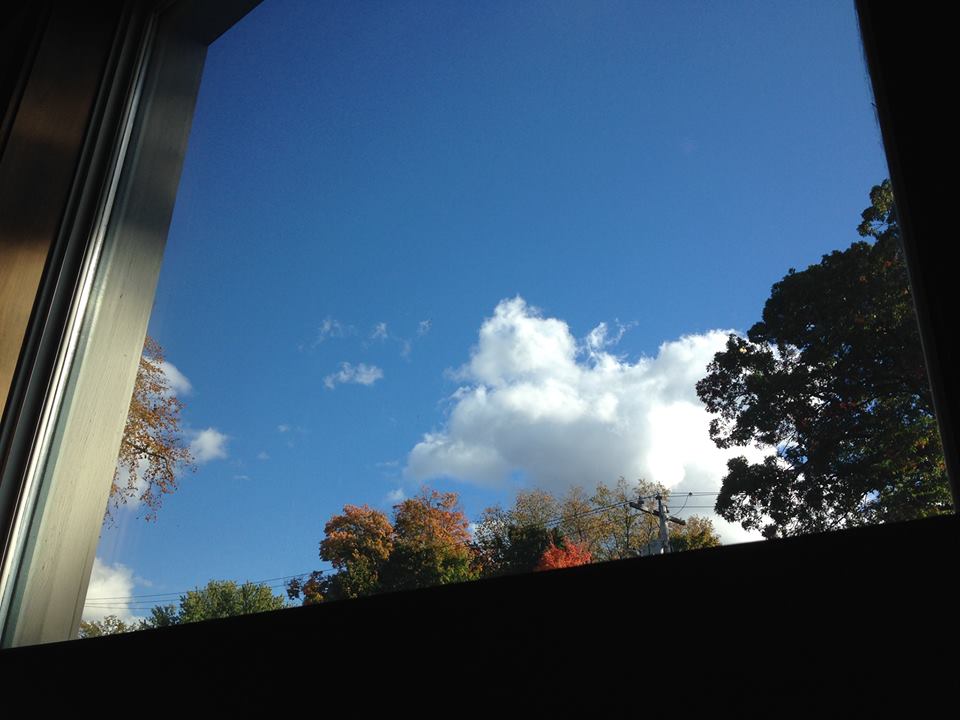
Temple sky over David’s “Blast-Off”
David Tasgal
1942-2015
To find out more about David’s approach to teaching violin, or to purchase his curriculum, see his website: Strings Fun and Easy.
(This is part of a series dedicated to our local elementary school–the heart of our community–on the occasion of my last child’s graduation… count down–two weeks!)
Caroling, another Marlboro Elementary Tradition 2014, Junior High, Whetstone Inn
As an army brat and the oldest of eight children, I’ve seen my share of school performances–in places near and far.
Add to that the decades as an elementary teacher and you could say I’m a school concert officianando. (Lucky me!)
And just in case your experience is more limited than mine, I’m here to let you know that Marlboro Elementary School (MES) events are by far the cream of the crop.
I saw my first MES performance in 1994 at Marlboro College, and felt the first quickening of my first born right in the Whittemore Theatre, aisle three, center left.
A handful of years later, that same child was on the stage exposing his belly to the audience in a kindergarten performance that was well past his bedtime.
The following year, he was in the “orchestra” sounding percussion for his class play beside his best buddy. After watching the sword dance, Timmy leaned over and whispered to Lloyd: “How will we EVER do that?!”
A couple feet later with deepening vocal fluctuations, there they are, teenagers, dancing in the dark, with glowing sticks.
If Marlboro’s Holiday Concert isn’t your idea of a fun night out, it might help to look at it through the eyes of an anthropologist. The rites of passage steeped in the curriculum that music teacher Charlene Morse offers, matches that of those tight knit cultures we admire.
From the enthusiastic participation of the primary room to the grumbling of the junior high, it’s all good–the stuff of coming of age in a strong community. The Youngers look up to the Olders, and the Olders look up to the Alumni–who voluntarily return to the place they once couldn’t wait to leave.
There is Joseph, a Marine, standing on the stairs beside his fifth-grade teacher, David Holzapfel.
His brother Jesse is back on the stage playing drums.
There is Harry speaking to the audience–channeling the love of our community–to MES graduate Jesse Lopata at Dartmouth Hitchcock.
There is baby Chloe toddling now and there is baby Dylan, speaking!
Families who haven’t seen each other since summer days at South Pond reconnect, sharing snow and power-outage woes with continued offers of help.
Recent MES graduates linger in the lobby and the whole Reichsman family traipses by with equipment in their arms.
Winter is upon us and once again the pot of our community is stirred.
Field Research has been the cornerstone of this little school in the Green Mountains of Vermont–at the grassroots level within its small flourishing community–to the State Capital and the Nation’s Capital–to the Atlantic coast and the shores of NYC–and finally to Central America–in its capstone work for graduating students.
This spring research trip for 22 Junior High studentscenters around the question: Vermont to Monteverde, How are we connected? To unravel this question, 7th and 8th graders have been studying international trade—focusing on coffee and tourism—and the influence of human behavior on local and global ecologies.
“Schools have always tried to foster responsible citizenry, and more than ever we must consider what it means to be a global citizen,” says Principal Francie Marbury. “Our middle school curriculum fosters global awareness through culture, economics and ecology. Students learn learn basic skills, and prepare for their the future in the best way—by being actively engaged in real world problems and solutions.”
Classroom teachers Rachel Boyden and Tim Hayes outline the educational components of the field research trip to Costa Rica:
Practice of Democracy: Students make real decisions about the classroom, fundraising, and the parts of the curriculum using a government they chose.
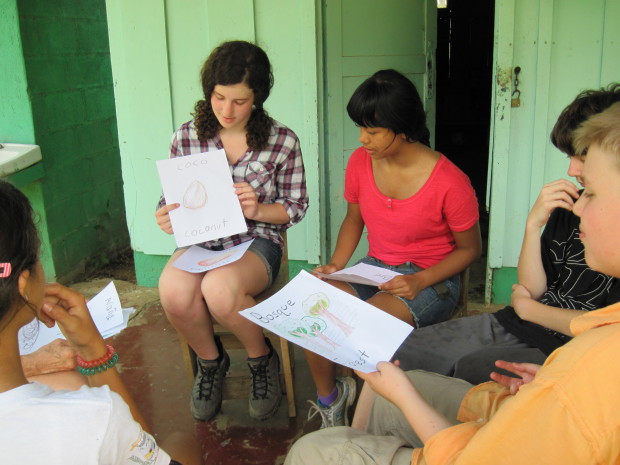
Spanish Language: Nothing makes a foreign language more relevant than traveling. While in Central America we will be visiting schools and using the language skills we have been developing in class to get to know the people and places of Costa Rica.
Social Studies: From an understanding of world trade from the Silk Road to the Atlantic Slave Trade, we look specifically at the economics of the coffee & tourist trade as they connect the United States and Costa Rica.
Ecology: Due to global warming and deforestation in the lowlands, the montane cloud forests of Monteverde are particularly vulnerable with numerous rare species threatened. This illuminates the unintended impact of human activity on ecosystems–a theme for ecology our classes.
For many students, this will be their first time out of the country or their first time on a plane. Some will credit this journey for shaping a lifetime of world travel and study. Others will mark it as their single trip abroad. ALL will return home with a broader perspective of the world in which they live and a greater sense of what it means to be a global citizen.
With 2 months left to go, the students have already raised close to 75% of the overall costs, enabling all students to participate regardless of ability to pay.



 We tucked our celebration away at the end of December, but the holiday season has dragged into the New Year for our family–by the Merry Mulch Fundraiser.





 This Vermont Life