Has going to school become a risk for our children, even in the United States?
This is the question I ponder after receiving an automated message saying that a threat in our district has resulted in increased security– even here, at our tiny elementary building in rural Vermont.
Columbine. When my husband considered shifting from elementary to high school, his safety was my first concern. Who knew that within a decade, violence wouldn’t be limited to teenagers.
Map delineating 387 school shootings since 1992.
“What will be our new normal?” asks a friend.
I think it has already come.
Sobering statistics creep up on us revealing that 387 school shootings have taken place since 1992; and that children in America are 13 times more likely to be murdered with guns as children in other industrialized nations.
“I’m not going to school tomorrow, Mom,” my oldest tells me after we get the call about the threat. “What I learn in a day isn’t worth my life.”
What about 14 year-old Malala Yousafzai–shot in the head for encouraging fellow girls to pursue an education in Pakistan? Shouldn’t education in the land of the free be that valuable?
Or have we become that cheap?
Kelly Salasin, lifelong educator, mother of 2, January 2013
So the violence that has spread through our Nation has reached our community–with a phone call telling us that our schools will receive extra patrol this week due to a threat.
That’s all we know.
Do we really want to know more?
Are we supposed to send our kids to school now?
Is this a test?
“Mom, I’m not going. One day of school isn’t worth it. I’ll be lying there shot on the floor thinking, ‘What a waste.'”
This is what it’s come to. Our children are casual with the possibility of being shot at school.
“Lock the doors!” parents holler.
But Sandy Hook was locked.
I do think we need to be cautious about threats, but I also think we need to be cautions of our fear. This is a society riveted by violence. Defined by it in many ways. Proud of it. We don’t want to encourage those who are prone to acting it out by titillating them with our hysteria.
Local educator, Dan Braden, just returned from the March on DC with his young family. He makes this suggestion to channel our angst:
It’s a great day to write your representatives at every level asking them to take action to reduce the number of weapons such as those used at Sandy Hook immediately.”
Another educator suggests we seriously ARM teachers in this bold statement that has been circulating around FB (from Mary Cathryn Ricker, the President of the St. Paul Federation of Teachers):
You want to arm me? Good.
Then arm me with a school psychologist at my school who has time to do more than test and sit in meetings about testing.
Arm me with enough counselors so we can build skills to prevent violence, have meaningful discussions with students about their future and not merely frantically adjust student schedules like a Jenga game.
Arm me with social workers who can thoughtfully attend to a student’s and her family’s needs so I. Can. Teach.
Arm me with enough school nurses so that they are accessible to every child and can work as a team with me rather than operate their offices as de facto urgent care centers.
Arm me with more days on the calendar for teaching and learning and fewer days for standardized testing. Arm me with class sizes that allow my colleagues and I to know both our students and their families well.
Arm my colleagues and me with the time it takes to improve together and the time it takes to give great feedback to students about their work and progress.
Until you arm me to the hilt with what it will take to meet the needs of an increasingly vulnerable student population, I respectfully request you keep your opinions on schools and our safety to yourself NRA… “
Against my better judgement, I signed up to work the cheese “stroll” following the annual Heifer Parade, thereby prolonging the mayhem of Brattleboro–instead of making the mad dash out of town right after Bernie waves–which is when the crowd cheers and moves en masse toward the fair upon the “Retreat” Grounds–which I might have to check into after today.
When I descend the steep hill from the Town Green to the fields below, and find my way to the Co-op’s tent, I am surprised to discover that I won’t be standing right behind the platters of cheese like I’ve seen workers in aprons do in years past. Instead, the role that my husband and I are assigned to is: behind the lines to cut the cheese. (I never noticed those people before.)
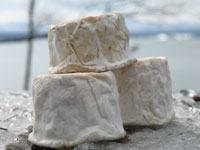
Champlain Valley Creamery’s beautiful soft ripened triple crème cheese with a bloomy white rind
I’ve never cut the cheese either, and as I attempt to learn the varieties in front of me, I wonder why the coordinator doesn’t just rely on member workers from her own department. It would make her job simpler; but she says that she likes to spread the wealth. And spread, we do; because Casey and I are assigned to the spreading table.
Olive and herb goat cheese.
Camembrie.
Triple Cream.
Bijou.
Ash.
After an hour, I find myself in a rhythm of cutting and spreading, discreetly placing the broken rice things dipped in cheese aside for my own covert snacking; and carefully wiping the leftover cheese crumbles from the cutting board onto my salad for the lunch I will eat when this two hour shift is done.
I’ve never realized how sensual a cheese can be; and despite the heat and the crowds, I am happy. I don’t care how much cheese people eat, and whether they appreciate it, or whether they consider visiting the Co-op to buy it, because I am one with the cheese, and its virtue transcends consumerism.
I am so happy (and a bit delirious) that when it is finally time for me and cheese to part, that I decide to stick around at the fair, and listen to music, and dance, and eat my salad with the assorted cheese crumbles.
Somehow cutting the cheese made the difference between fleeing from–and floating through–this afternoon in Brattleboro.
I am still on the grounds when the day closes, licking brie from my fingers.
It’s not that cheese is new to me. I’ve visited France. And I’ve always appreciated the cheese department of the Brattleboro Co-op–back to the days when Henry cut the cheese.
But now I have a greater intimacy with this craft. It’s become personal–and local–made right here in the Green Mountain State– by small farms with names I know~
Jasper Hill Creamery.
Champlain Valley Creamery.
Vermont Butter & Cheese Creamery.
Blythedale Farm…
Now when I’m shopping, I pause even longer at the cheese counter… My husband and I pick up one familiar soft friend after another, and gently caress it like a lover. We consider signing up for the same shift next year, and in the meantime, we decide to make a date with a baguette, a bottle of wine, and some artisanal cheeses from around our state.
Kelly Salasin, June 2011
ps. Casey & I did sign up to work the cheese stroll in 2012–and cheerfully reported to duty–even in the pouring rain.




 This Vermont Life